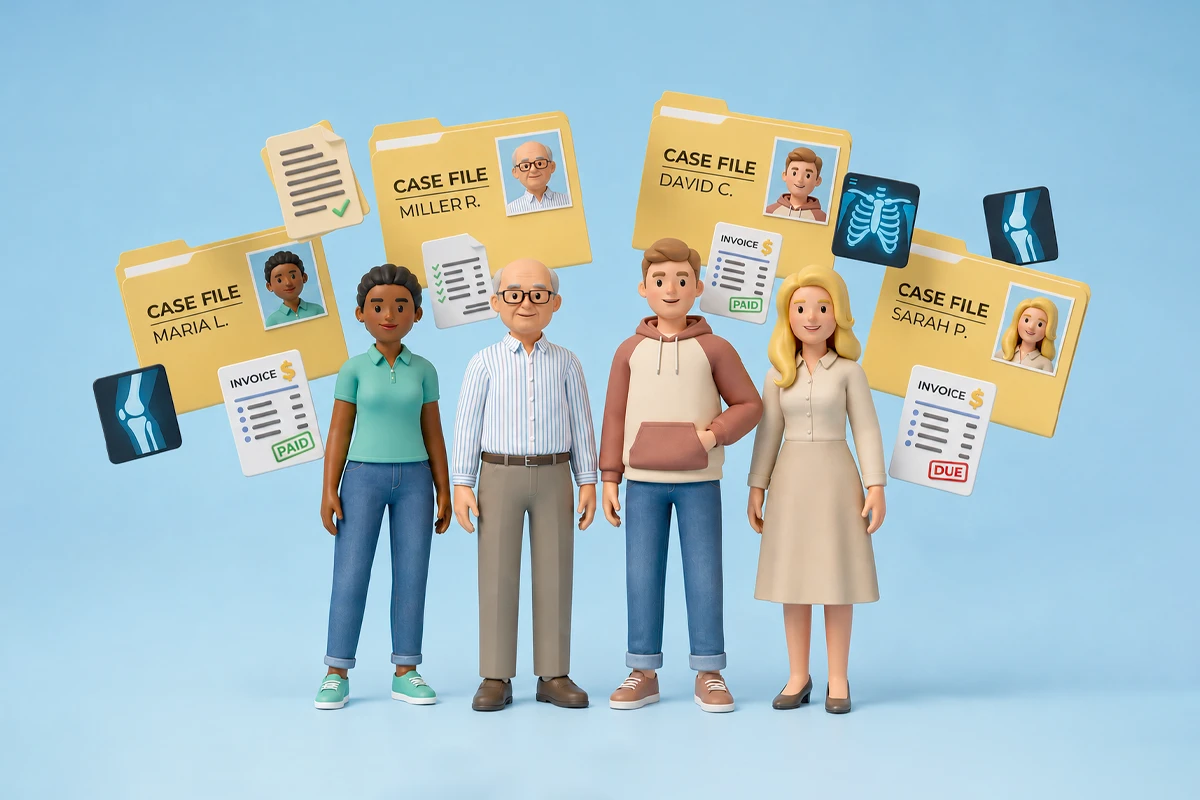
Healthcare practices do not simply manage clients. They manage evolving situations, treatment journeys, documentation requirements, payer relationships, approvals, reassessments, billing activity, and team coordination.
That distinction matters.
A client or patient may remain with a clinic for years. But each reason they come in for care has its own story, its own timeline, its own billing rules, its own documentation, and often its own providers. A motor vehicle accident is not the same as a workplace injury. A sports injury is not the same as a slip and fall. A mental health case connected to trauma is not the same as a separate physiotherapy case for shoulder pain.
Yet many practice management software systems still treat the patient record as the main container for everything. That may work for simple care environments. But in rehabilitation, physiotherapy, chiropractic, occupational therapy, mental health, and multidisciplinary clinics, that structure can quickly become limiting.
Modern clinics need more than patient management as they navigate their digital transformation and diverse clinical use cases.
They need case-centric practice management.
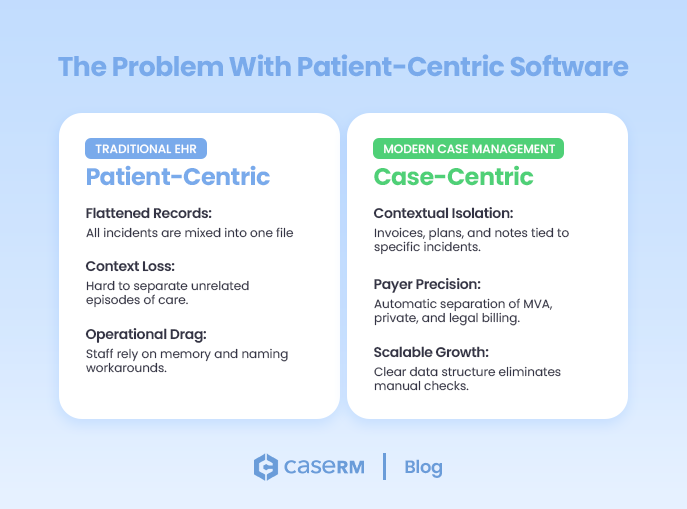
The Problem With Patient-Centric Software
Traditional EHR and practice management systems are usually built around the patient profile. The system asks: who is the person?
That is an important question, but it is not enough.
Modern care also requires the system to ask:
- Why is this person receiving care?
- What incident or condition is this treatment connected to?
- Who is paying for this episode of care?
- Which providers are involved?
- Which documents belong to this specific case?
- Which treatment plan applies?
- Which appointments, invoices, payments, and reassessments belong here?
- What information can be shared with an insurer, lawyer, employer, or regulatory body?
When software organizes everything under one general patient file, unrelated episodes of care can become flattened into the same record. Chart notes, documents, correspondence, invoices, payments, treatment plans, and insurer communications may all sit together without enough contextual separation.
For one patient, that may still be manageable.
Across dozens, hundreds, or thousands of patients, it becomes an operational problem.
The clinic may still function, but staff begin relying on memory, notes, workarounds, naming conventions, manual checks, and internal habits to keep everything straight. That is not scalable. It is not clean. And it creates unnecessary risk.
Patients Are Permanent. Cases Are Contextual.
This is the core distinction. A patient is the person receiving care, while a case file is the organized record of a specific episode of care. The patient record identifies who the clinic is serving; the case file explains what situation is being managed, why treatment is taking place, and how the work around that care episode should be organized.
That episode of care may be connected to a motor vehicle accident injury, a workplace injury, a sports injury, a slip and fall, a private treatment plan, a multidisciplinary rehabilitation program, a mental health case, an occupational therapy assessment, or another defined care pathway. Each one carries its own context, and that context matters.
The same patient can have more than one active case at the same time. They may be receiving physiotherapy for a workplace shoulder injury while also attending treatment for a separate unresolved injury from a previous motor vehicle accident. One case may involve an insurer, adjuster, and treatment plan approvals, while another may involve private billing or a different group of providers altogether.
A patient-centric system often struggles with this complexity because it treats the person as the main container for everything. A case-centric system treats the episode of care as the operational unit, allowing each case to maintain its own structure while still remaining connected to the same client record.
That is the difference.
What Is a Case File?
A case file is a structured digital workspace for one episode of care.
It is not just a folder. It is not just a label. It is not just a note category.
A proper case file brings together the information, activity, and workflow connected to a specific care situation to optimize the delivery of care.
A well-organized case file may include:
- client or patient demographics
- intake date
- case type
- case ID
- payers and billing responsibility
- treatment plans
- reassessment timelines
- appointments
- clinical notes
- documents and attachments
- medical images
- assessment reports
- progress reports
- invoice and payment transactions
- outstanding balances
- correspondence records
- insurer communications
- legal letters
- case contacts
- provider involvement
- discharge or closure details
This structure gives the clinic a clearer operational foundation. Instead of asking staff to mentally separate everything inside one crowded patient profile, the system itself keeps each episode of care organized.
That is what case-centric practice management is really about.
Why Multiple Cases Under One Patient Create Operational Risk
Consider a patient who attends a clinic for two unrelated injuries.
The first case is connected to a motor vehicle accident. It involves an insurer, treatment plan approvals, accident-related documentation, legal correspondence, and specific billing rules.
The second case is a private sports injury. It involves a different treatment goal, different documentation, different billing expectations, and possibly different providers.
If both cases live inside one general patient file without clear separation, the clinic now has to manually determine which notes, charges, documents, and communications belong to which situation.
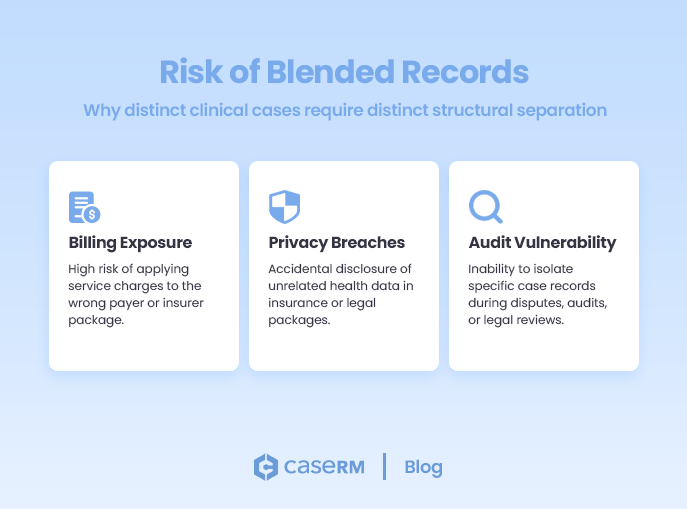
That creates room for mistakes.
The wrong document may be included in an insurer package. A service charge may be applied to the wrong payer. A provider may review notes that are not relevant to the case they are treating. Billing staff may need to investigate which appointment belongs to which episode of care. During an audit or dispute, staff may need to manually cherry-pick records from a mixed patient file.
This is not just inconvenient.
It affects billing accuracy, documentation integrity, staff efficiency, privacy, reporting, and audit readiness.
A growing clinic cannot build reliable operations on unclear record structure.
Billing Works Better When Appointments Belong to Cases
One of the strongest advantages of case-centric practice management is that appointments are booked per case file, not merely per client.
That sounds like a small design choice.
It is not.
It changes the entire downstream workflow.
When an appointment belongs to a specific case, the service charge connected to that appointment naturally lands in the corresponding case file. The billing activity remains tied to the correct episode of care. The payer relationship is clearer. Invoices, payments, approvals, and outstanding balances can be managed in context.
In a patient-centric system, billing staff may have to determine after the fact where a charge belongs. Was this physiotherapy visit connected to the MVA case? Was it part of the workplace injury? Was it private treatment? Was it related to a different active care plan?
That uncertainty creates administrative drag.
Case-centric workflow reduces that friction to streamline operations by connecting scheduling, billing, and documentation from the beginning.
This is especially important for clinics that manage MVA cases, WCB or WSIB cases, slip and fall injuries, extended health benefit claims, multidisciplinary rehabilitation programs, private-pay treatment, and mixed payer environments. In these settings, billing is rarely just a simple transaction between the clinic and the patient. Each case may involve different payer rules, approval requirements, supporting documentation, invoicing expectations, and payment timelines. When care is organized around the right case file, billing becomes cleaner because the operational context is already built into the workflow.
Insurers Need Case-Specific Information
Insurance-driven care depends on relevance.
When information is sent to an insurance adjuster, legal representative, employer, or payer, it must relate to the specific case being reviewed. An insurer responsible for one incident should not receive unrelated documentation connected to a separate injury or treatment episode.
That means clinics need clear separation between case-specific chart notes, assessment reports, progress updates, treatment plans, approval requests, invoices and oustandings, correspondence, and supporting documents. Each of these records may be reviewed by different people for different reasons, including insurers, adjusters, legal representatives, providers, billing staff, or regulatory bodies. When they are organized inside the correct case file, the clinic can respond to requests with greater accuracy and less manual sorting. Case-centric organization makes this easier because the relevant information is already grouped around the episode of care it belongs to.
Instead of manually searching through a broad patient record, staff can work from a structured case file that already contains the relevant materials. During audits, disputes, insurer reviews, or payment follow-ups, the clinic can respond with more confidence.
Organization is not just an internal convenience.
In regulated and insurer-driven environments, organization is protection.
Multidisciplinary Care Requires More Than a Shared Patient Record
Modern healthcare is increasingly collaborative. A single case may involve various team members, including physiotherapists, chiropractors, occupational therapists, massage therapists, mental health professionals, physicians, case managers, administrators, billing staff, and external contacts. That level of collaboration works best when everyone involved can access the right information in the right context, without having to sort through unrelated records, documents, or treatment history. A case-centric structure helps keep each provider’s work connected to the specific episode of care they are supporting.
But the same patient may have another case involving a different provider group, different documents, different goals, and different privacy considerations. The team involved in one episode of care may not need access to every detail connected to another unrelated case.
Case-centric practice management supports cleaner collaboration because it allows care to be organized around the specific situation being treated.
The case becomes the shared workspace.
The patient remains central, but the work is organized around the episode of care.
That is how multidisciplinary clinics maintain clarity as care becomes more complex.
Adaptive Case Management Reflects How Modern Care Actually Happens
Older workflow systems often depended on predefined, hard-coded processes. They assumed that work followed a predictable sequence.
Real healthcare does not always move in a predictable sequence. A case may change direction because of a phone call, an email, a fax, an insurer request, a new assessment, a missed appointment, a legal letter, a reassessment requirement, a provider recommendation, a treatment plan approval, a denied claim, a new symptom, or a change in the patient’s condition. Each of these events can introduce new information, create follow-up work, change priorities, or require the team to adjust the care plan. This is where adaptive case management in healthcare becomes important.
Adaptive case management recognizes that knowledge workers often need to guide the direction of a case and improve decision-making based on new information. The workflow evolves in real-time as events occur. A case is not simply a static folder containing notes and documents. It is a connected, evolving operational record that moves toward resolution.
In a modern clinic, the case file should support that reality.
It should allow new information to enter the case, trigger follow-up work, support parallel activities, and keep the team aligned without forcing every situation into a rigid workflow.
That is why case-centric practice management and adaptive case management belong together.
One provides the structure.
The other provides the flexibility.
Why Case-Centric Practice Management Matters More Today
Healthcare operations are more complex than they were ten years ago.
Clinics are managing more digital documentation, more payer rules, more communication channels, more multidisciplinary teams, and higher client expectations. Patients expect convenience. Providers expect access to relevant information. Administrators need clean workflows. Owners need visibility. Payers expect accurate documentation. Regulators expect proper recordkeeping.
A simple patient profile is no longer enough for many healthcare environments.
Clinics need software that can manage care in context. That means organizing work around the patient, the case, the provider team, the payer, the treatment plan, the documentation, the billing workflow, the communication history, and the full lifecycle of the episode of care. When these elements are connected inside the right case file, the clinic gains a clearer view of what happened, what is happening now, what still needs to be done, and what information may be needed for billing, reporting, coordination, or closure.
This is especially important for physiotherapy clinics, rehabilitation clinics, chiropractic clinics, occupational therapy practices, mental health providers, and multidisciplinary health organizations that treat a variety of conditions across different case types.
The more complex the clinic, the more important the structure becomes.
The Old Model vs. The New Model
The old model organizes care around the patient only.
That model can flatten unrelated episodes of care into one general record. It can create confusion between documents, notes, invoices, payers, and treatment plans. It can make insurer workflows harder to manage. It can force staff to rely on manual interpretation instead of clear system design.
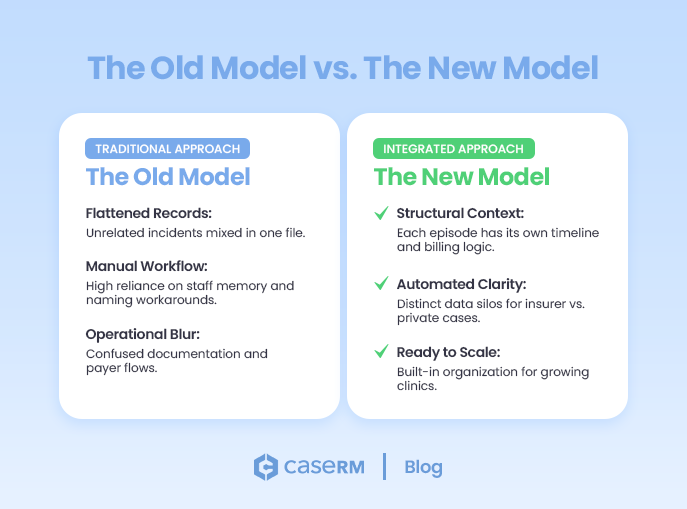
The new model organizes care around both the client and the case.
That model recognizes that the patient is the person, but the case is the operational context. It gives each episode of care its own structure, timeline, documentation, billing activity, providers, contacts, and closure process.
The old model asks:
Who is the patient?
The new model also asks:
What case are we managing?
That second question is where operational clarity begins.
CaseRM: Built Around Case Files
CaseRM was designed with this distinction in mind.
Rather than treating case management as an afterthought inside a general patient profile, CaseRM is built around the reality that many healthcare professionals manage care through case files.
Each case can maintain its own structure, including documentation, appointments, billing activity, correspondence, treatment information, case contacts, and payer relationships. This helps clinics keep unrelated episodes of care properly separated while still maintaining a unified client record.
That matters because real-world clinics rarely operate in a straight line. They manage multiple providers, multiple payers, multiple locations, multiple case types, and multiple workflows at the same time.
CaseRM supports that complexity through a case-centric foundation designed for modern healthcare operations.
It helps clinics move from scattered information to structured workflows.
From patient-only records to episode-of-care management.
From administrative guesswork to operational clarity.
And with a full-time license for everyone and transparent pricing, clinics can give their team access without creating artificial barriers around who can participate in the workflow.
A Smarter Way to Manage Modern Care
Managing clients is important.
But managing clients alone is not enough.
Modern clinics need to manage the full context of care: the incident, the documentation, the treatment plan, the providers, the payer, the communication, the billing, the reassessments, and the path toward closure.
That is what case files make possible.
Case-centric practice management is not simply a different way to store information. It is a better operational model for clinics that deal with complex care, multidisciplinary teams, insurance workflows, and evolving treatment journeys.
The future of healthcare software is not just about larger patient records.
It is about better-organized care.
And better-organized care starts with the case file.