No-shows are one of the quietest but most expensive operational leaks in modern clinics. They create a significant ripple effect for both healthcare administrators and patients. If you’re a practice owner, understanding why no-shows happen and how to reduce them is essential to your clinic’s efficiency and financial health.
In this article, we’ll break down the latest findings on why patients miss appointments and what clinic owners and managers can do to cut no-show rates significantly.
No-Shows Aren’t Just a Scheduling Issue
In busy outpatient clinic scheduling environments, even a few missed visits per week can ripple through waitlists, staffing models, and billing cycles.
A missed patient appointment doesn’t just waste a time slot – it triggers a chain reaction across your clinic. Clinicians lose valuable treatment time. Staff resources go underutilized. Patients waiting for earlier access miss out. And if no-shows pile up, your operational efficiency takes a serious hit.
Studies show that high no-show rates can lead to revenue losses of up to 30% in busy outpatient settings. For clinics operating with thin margins, that’s a big problem. The indirect costs are just as hard: burnout from unpredictable schedules, disengaged patients, and wasted administrative time on rebooking and follow-up.
This is why addressing patient scheduling and patient access isn’t optional. It’s core to sustainable clinic operations.
Each of these reasons points to something deeper: what happens before and after the appointment matters as much as the session itself.
And it all starts with patient engagement.
When healthcare providers engage patients early and clearly communicate the value of their treatment plan, patients are far more likely to commit to the full course of care. Successful healthcare practices know that the patient experience doesn’t start at check-in – it begins the moment the appointment is scheduled.
Top Reasons Patients No-Show
Across multiple studies from 2024 and 2025, here are the most common reasons patients in physio, chiro, and similar clinics skip appointments:
- Perceived recovery: “I felt better after one session, so I didn’t think I needed more.”
- Access issues: Difficulty with transportation, long travel times, or poor parking.
- Financial concerns: When care is costly, not covered by insurance, or simply unaffordable, patients may decide to skip the appointment altogether.
- Inconvenient timing: Appointments that don’t fit around work, school, or family.
- Forgetfulness: No reminder or unclear communication.
- Lack of perceived value: Patients don’t see how the session connects to real progress.
- Therapist relationship issues: Poor communication or lack of trust.
- Other health priorities: Competing treatments or conditions.
These reasons hold up globally. Studies in Canada, Nigeria, and Saudi Arabia have highlighted similar patterns – proving that the root causes are less about geography and more about human behavior, life complexity, and poor system design.
Patient communication must be proactive. Automated appointment reminders and effective patient scheduling strategies help clinics reduce missed visits. When communication fails, no-shows rise.
Who’s Most Likely to Miss Appointments?
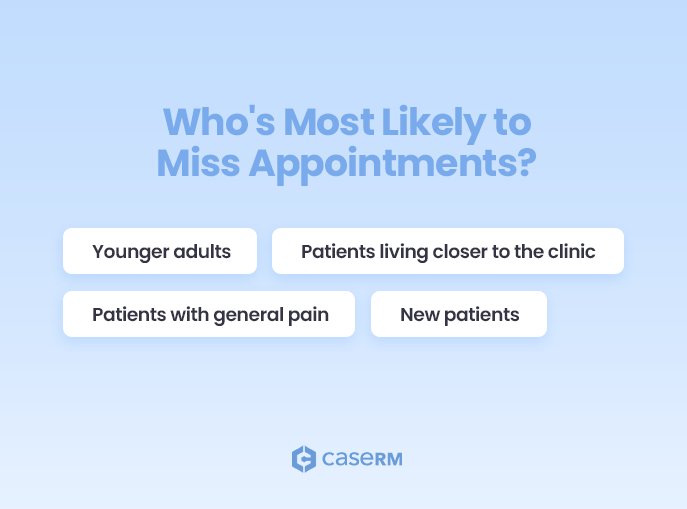
The data shows clear patterns:
- Younger adults (late teens to 40s) tend to miss more appointments than older patients.
- New patients are more likely to no-show compared to those in ongoing care.
- Certain visit types, like general pain or wellness care, have higher no-show rates than post-surgical or rehabilitation-focused visits.
- Interestingly, some studies found patients living closer to the clinic were more likely to miss than those traveling longer distances.
- Female patients in some regions reported slightly higher no-show rates, though this isn’t consistent across all studies.
Understanding these trends allows healthcare providers to personalize their approach. For instance, sending targeted appointment reminders to high-risk patients or using practice management software to flag repeat no-shows can help intervene before the pattern gets worse.
Rethinking Patient Access in Modern Healthcare
Today’s patients expect convenience. They want care that fits into their schedules – not the other way around. If your healthcare practice still relies on phone-only booking, long wait times, or rigid cancellation rules, you’re creating friction that contributes directly to no-shows.
Digital patient tools like self-service portals and mobile-friendly appointment scheduling reduce barriers to care and give patients more control over their visits.
Online booking systems are no longer a “nice-to-have.” They’re essential tools for reducing no-shows and improving patient experience. When patients can manage their own appointments – book, reschedule, cancel – 24/7, the forgotten or missed appointments drop significantly.
Online booking also gives patients more perceived control, and studies show patient autonomy strongly predicts follow-through with care plans.
If you want higher attendance, increase patient access and simplify patient scheduling. That starts with modern tools and continues with clear communication.
What Actually Works to Reduce No-Shows?
Here’s what recent research says can make a real difference:
1. Nurture Stronger First Visits
Patients decide early whether they believe in your care plan. That first session should build trust, clearly explain goals, and make the value of ongoing care obvious. If they don’t understand why they need to return, they won’t.
Clinics that use the first visit to walk patients through the treatment timeline, explain success markers, and set expectations see lower drop-off rates. This improves patient satisfaction and builds loyalty from day one.
When patients feel seen, supported, and informed, they’re more likely to return. When they feel like just another name on the schedule, they ghost.
Improving patient experience means investing in the entire patient journey – not just the treatment room.
2. Utilize Smart Appointment Reminders
Automated appointment reminders are one of the most cost-effective tools available to healthcare providers. And yet, many clinics underuse them or send generic, ineffective messages.
Strong reminder systems combine:
- Multi-channel delivery (text, email, phone)
- Smart timing (48 hours and same-day)
- Call-to-action prompts (“Confirm” or “Reschedule”)
- Personalization (include patient name, clinician name, visit type)
Don’t forget follow-ups. If no confirmation, send another nudge. A clear appointment confirmation process helps reduce uncertainty and boosts attendance. If they no-show, follow up within 24 hours with a rescheduling link. These touches improve patient engagement and cut attrition.
Your practice management software should support these workflows automatically. If it doesn’t, you’re leaving efficiency and revenue on the table.
3. Extend Reminders into Patient Retention Outreach
Beyond appointment reminders, leading health systems use scheduled patient retention notifications to maintain engagement between visits. These messages are sent on a defined cadence with clear, purpose-driven outreach – not generic marketing.
A typical flow might include a welcome email after the first visit, followed by a check-in at 2–4 weeks, then another at 6–8 weeks. The goal isn’t to sell – it’s to reinforce the value of care, remind patients why consistency matters, and keep the treatment plan top of mind.
When retention outreach is automated and thoughtfully timed, patients feel supported rather than chased. Clinics see fewer silent drop-offs, stronger follow-through, and more predictable schedules.
4. Offer Easy Rescheduling
If cancelling is easier than rebooking, people disappear. Quick options to move appointments without calling – like self-service portals or one-tap links – help retain them.
User-friendly practice management software enables seamless rescheduling, putting patients in control while making your system more efficient.
5. Put Patients in Control
Evening hours, shorter visits, or online sessions help patients fit care into their lives. Rigid schedules often lead to higher no-shows.
Many healthcare providers try to reduce no-shows by tightening rules or threatening fees. But a better long-term strategy is to build shared responsibility.
Include patients in their own scheduling decisions:
- Ask what time of day works best
- Allow same-day online booking and changes
- Enable one-click confirm or cancel
This flexibility increases accountability. When patients own their appointment, they’re less likely to abandon it.
It’s especially key for younger patients and those with variable schedules – groups statistically prone to no-shows.
6. Use Data to Drive Strategy
Every healthcare practice already holds the data to understand and reduce no-shows – it just needs to be used.
Track trends over time:
- Which days of the week have more missed appointments?
- Are morning or afternoon slots riskier?
- Which patient demographics cancel the most?
- Do new patients cancel more often than returning ones?
Spot patterns, then act: schedule high-risk patients in less volatile hours, send additional appointment reminders to younger or first-timers, offer more online booking slots for missed visit types.
Data-driven scheduling isn’t just about filling slots – it’s about operational efficiency, reducing waste, and optimizing your team’s time.
Effective patient care coordination also means recognizing how no-show patterns impact follow-up planning, therapist availability, and continuity of care.
7. Reinforce the Value of Care
Patients who grasp the risks of skipping are more likely to show. Phrases like “Each missed visit can slow your recovery by X days” connect attendance to outcomes.
Don’t stop educating after the first visit. Continue reinforcing the benefits of sticking with the plan. Patient engagement doesn’t stop at the front desk – it’s a continuous process.
8. Step up with a Friendly Follow-Up
When a patient no-shows, don’t just update the appointment status in the calendar. Call or message: “We missed you today – can we help reschedule?” It shows you care and keeps the door open.
For high-risk patients, follow-up within 24 hours. A gentle nudge brings them back before they check out.
Automated follow-ups and integrated reminder systems make this consistent, without burdening your team.
Enforcing Policies and Fees
Clear no-show and cancellation policies set expectations and protect your time. Some clinics hesitate on cancellation fees, fearing lost patients. Others swear by them.
Research says it depends. No-show policies work when clearly communicated and applied fairly:
- Charge a small fee for late cancellations or missed appointments without notice.
- Waive the first as a courtesy, then enforce consistently.
- Make it easy to cancel or reschedule across channels.
The goal isn’t punishment – it’s expectations. When patients know appointments have value (and a cost to skip), they take them seriously.
Stay flexible – emergencies happen. Balance firm policy with human judgment.
Policies shine when paired with the strategies above. You can’t fine your way to better attendance, but a wise fee closes the loop.
Practice management software helps by auto-tracking no-shows, issuing invoices, and sending policy reminders via patient communication tools.
Train Your Team to Spot Risk Early
Tech streamlines appointment scheduling and patient communication, but frontline staff spot potential no-shows first. Every interaction – front desk, phone, in-session – is a chance to catch red flags.
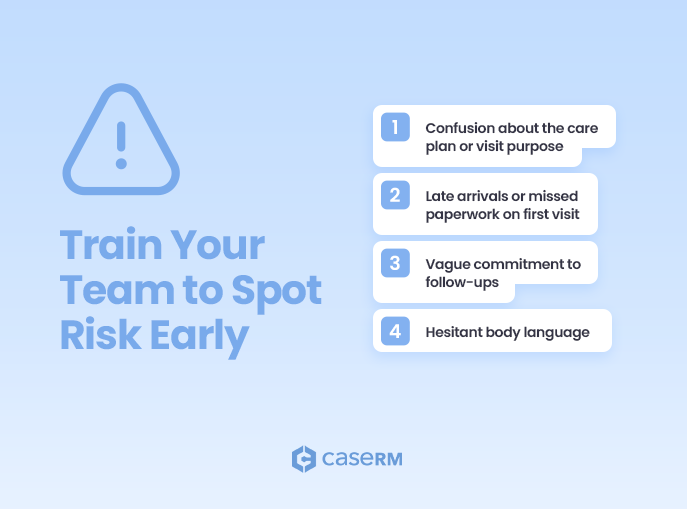
Train them to notice:
- Confusion about the care plan or visit purpose
- Late arrivals or missed paperwork on first visit
- Vague commitment to follow-ups
- Hesitant body language
When these cues surface, a gentle check-in can help. A team member might say, “How are you feeling about the treatment plan?” or “Would it help to walk through the next session?”
Empowering your team to ask thoughtful questions and build rapport reduces anxiety and boosts follow-through. Pair this with your practice management software’s no-show tracking, and you’ve got a human-plus-digital safety net to support patient care and protect clinic time.
What About Telehealth?
Sometimes a virtual option saves an appointment from a no-show. If travel or work blocks them, a quick video/phone check-in keeps care moving.
Research shows telehealth appointments often have slightly lower no-show rates than in-person visits – especially for follow-ups or non-hands-on treatments. While telehealth may not work for manual therapy, it can still be part of your strategy.
Integrating telehealth into practice management software makes scheduling and follow up on virtual visits easy, keeping care consistent and reducing drop-offs.
A Word on High-Risk Patients
Flag habitual cancellers or no-showers:
- Offer them shorter time slots.
- Follow up more often.
- Require confirmation before booking.
- Schedule them at times less prone to no-shows (mid-week mornings often work well).
Quietly score based on history and build workflows to prevent repeats. This tightens your schedule and cuts waste.
Reminder systems and automated appointment reminders can be especially effective with high-risk groups – turning passive scheduling into proactive patient care.
Final Thoughts
No-shows are more than just a scheduling annoyance. They reflect how well your clinic communicates, how easy you make attendance, and whether patients believe the care is worth coming back for.
The good news? You don’t need expensive tech or complex systems. Most clinics can cut their no-show rates significantly with small, thoughtful changes.
- Make first visits count
- Use action-oriented reminders
- Provide easy rescheduling
- Be flexible when possible
- Enforce fair policies
- Follow up when people disappear
When patients show up, outcomes improve. Revenue stabilizes. Staff morale rises.
Most importantly, your clinic builds a reputation as a trusted place people stick with.
If your healthcare practice is serious about patient satisfaction, less waste, and stronger patient care, tighten appointment scheduling and patient engagement now.
Need more ideas? Audit your patient communication touchpoints, run a 3-month no-show report, and test one scheduling change at a time. Small steps lead to big results.
Sources and Research Notes
This article draws from recent studies on outpatient no-show rates and healthcare operations published between 2024 and 2025. Notable research includes findings from:
- The Canadian Journal of Pain Management
- U.S. outpatient and ambulatory care efficiency reports (2024–2025)
- Saudi Medical Journal
- The Nigerian Journal of Clinical Practice
These insights have been consolidated and interpreted to help physiotherapy, chiropractic, and acupuncture clinics strengthen operations and reduce no-show rates through practical, evidence-informed strategies.