
Behind every successful acupuncture practice is a surprising amount of work patients never see.
Acupuncture depends on precision, timing, and flow. So does the practice behind the treatment room. Every appointment, chart note, treatment plan, payment, reminder, report, and patient message has to connect cleanly, or the clinic starts to feel the strain. When that operational flow breaks down, missed appointments, scattered records, delayed invoices, incomplete documentation, and disconnected systems make even simple workflows feel heavier than they should.
For years, many acupuncture clinics relied on paper records, spreadsheets, basic appointment systems, or separate apps patched together out of necessity. That may work early on, but it rarely holds up as patient volume grows, providers are added, and billing or documentation demands become more complex.
Modern acupuncture practice management software has moved beyond appointment management and automated reminders. The right system can bring scheduling, patient records, treatment documentation, billing, online booking, reporting, communication, and other daily workflows into one organized environment. More advanced platforms go further by helping clinics manage care around treatment episodes, care plans, and the full journey from intake to recovery.
In this guide, we compare the best acupuncture practice management software for 2026, including features, pricing, strengths, limitations, and best-fit use cases. Whether you are a solo practitioner looking for simplicity or a growing group practice looking for a more integrated way to manage care, this comparison will help you choose software that supports your practice today and gives it room to grow tomorrow.
The Evolution of Acupuncture Practice Management in 2026
The operational landscape for acupuncture clinics has changed. The days of balancing a paper appointment book, physical charts, spreadsheets, and a standalone payment terminal are fading. Clinics are moving away from paper records and basic Electronic Medical Records toward HIPAA compliant, cloud-based platforms.
Today, clinics need more than digital storage. They need connected workflows where scheduling, billing, charting, patient communication, and reporting work together. Yet many cloud-based systems still revolve around appointments rather than care over time.
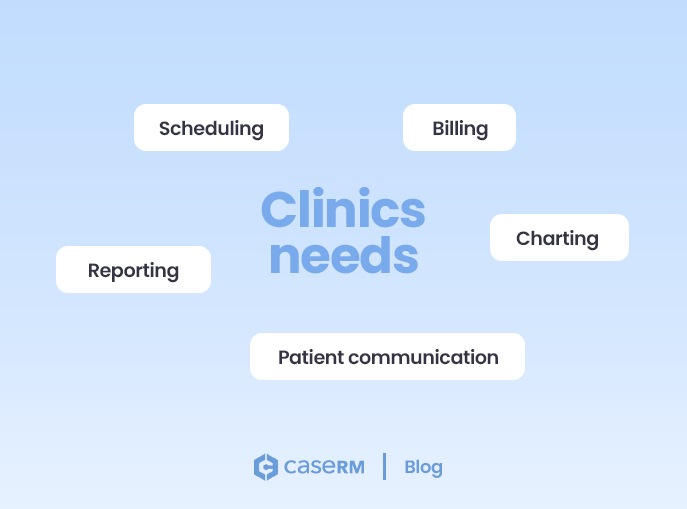
Most tools manage visits. Few actually manage care over time.
Acupuncture care often extends beyond a single appointment, supporting chronic conditions, injury recovery, fertility care, stress management, and multi-week treatment cycles. Yet many software platforms still treat each visit as a separate transaction rather than part of an ongoing episode of care.
From Appointment Booking to Full Practice Management
Traditional systems often operate on a fragmented, appointment-centered model:
Patient → Appointment → Note → Invoice
In this framework, the appointment becomes the center of the system. Consider a patient who has been coming to the clinic for several years for chronic pain, paying privately or using extended health benefits through an employer. This week, the same patient is involved in a motor vehicle accident and sustains serious injuries. In an appointment-centered system, those two care paths can quickly become tangled in one patient timeline, even though the documentation, billing rules, insurance coverage, treatment goals, and reporting requirements may be completely different.
The industry is beginning to move toward a more case-centric model:
Intake → Case File → Treatment Plan → Visits → Billing → Reassessment
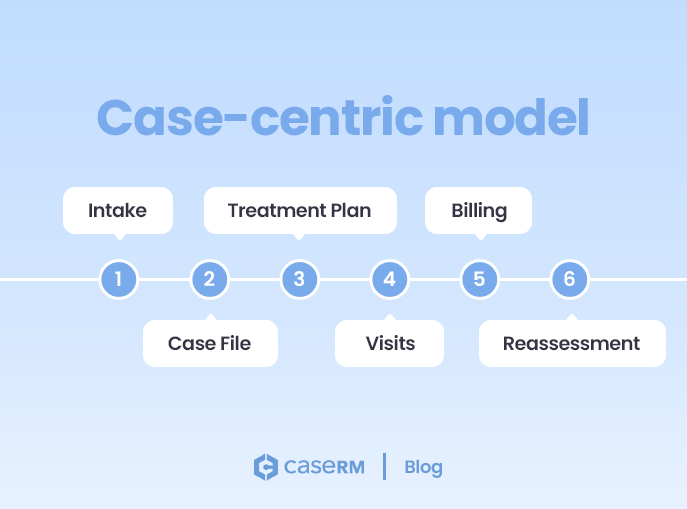
Instead of managing an endless list of visits, a case-centric system organizes activity around individual case files within a single client profile.
For acupuncture clinics, this creates an important operational distinction. If a patient is undergoing a treatment cycle for fertility support while also receiving care for an acute sports injury, those care paths can remain separate. Documentation, financial activity, treatment goals, billing rules, and appointment history can be managed within the proper case context.
Top Acupuncture Practice Management Software 2026 Review
The platforms below take different approaches to practice management. Some are built for acupuncture and Traditional Chinese Medicine, some serve broader allied health clinics, some focus mainly on charting, and others are better suited to service-based businesses such as salons, spas, and beauty studios.
This comparison looks beyond feature lists and focuses on how each platform supports real clinic operations, including scheduling, documentation, billing, pricing structure, integration, scalability, and workflow fit.
CaseRM: The Case-Centric Evolution of Practice Management Software
Overview
CaseRM is a cloud-based practice management platform built around the full case, not just the appointment. It brings scheduling, charting, billing, accounting, communication, contact management, reporting, and workflow automation into one connected operating environment.
Instead of organizing work mainly around individual visits, CaseRM structures information around distinct episodes of care. Clinics can manage treatment plans, documentation, billing, communication, related contacts, and financial records within each case while maintaining a complete client record.
For acupuncture clinics, multidisciplinary practices, and organizations managing ongoing care, this creates a practice management model built around how care is delivered over time, not just how appointments are booked.
Where It Excels
CaseRM’s primary strength is its case-centric structure. A single client can have multiple active or historical case files, allowing clinics to separate treatment episodes, conditions, claims, care programs, and payer relationships without losing the complete client record.
This is especially valuable for clinics managing chronic conditions, recurring treatment plans, motor vehicle accident claims, workplace injuries, wellness programs, or multidisciplinary care. Instead of forcing everything into one appointment timeline, CaseRM keeps documentation, bookings, billing, communication, contacts, and financial activity organized by case.
CaseRM also brings clinical, administrative, and financial workflows into one system. Scheduling, charting, billing, payments, accounting, contact management, and reporting work together instead of being split across disconnected tools. For growing clinics, that means less manual reconciliation, stronger context, and clearer visibility into each case from intake to payment.
Best Fit
CaseRM is best suited to growing acupuncture clinics, multidisciplinary practices, and organizations that need stronger coordination between care delivery, administration, billing, and financial management.
It is especially relevant for clinics managing multiple providers, recurring treatment plans, insurer relationships, complex billing workflows, or more than one active case per client. For practices planning growth, CaseRM offers a structure designed to handle increasing operational complexity without forcing the clinic to rely on separate systems for scheduling, documentation, billing, accounting, and reporting.
Pricing Model
CaseRM keeps pricing simple. The Solo plan starts at USD $29 per month, while the Team plan starts at USD $50 per month.
The Team plan includes unlimited full-time users and unlimited locations, making it a predictable option for growing clinics. Optional add-ons, such as online booking, can be added to extend the system’s functionality as needed.
Bottom Line
CaseRM stands out in this comparison because it moves beyond the appointment-centered model that still defines much of the practice management software market. Its case-centric structure, built-in accounting, centralized contact management, multi-calendar coordination, and simple pricing model support the full lifecycle of patient care.
For acupuncture clinics that want a more connected and scalable way to run the practice, CaseRM offers more than a set of separate software features. It brings clinical care, administration, communication, billing, and financial oversight together around the real-world cases clinics manage every day.
Jasmine: Acupuncture-Specific Documentation and Practice Tools
Overview
Founded in 2013, Jasmine is a cloud-based practice management and EHR platform for acupuncturists and holistic health providers. Running on Salesforce’s Force.com platform, it combines scheduling, online booking, patient management, customizable SOAP notes, digital intake forms, billing, insurance billing, and reporting in one system. It also integrates with services such as Fullscript for dispensaries, Mailchimp for marketing, Google Meet for telehealth, and SMS messaging.
Where It Excels
Jasmine’s main value is its TCM-specific charting and consent forms. Providers can track tongue and pulse diagnoses, manage herbal formulas, and record acupuncture point prescriptions directly within customizable SOAP notes.
That clinical focus gives Jasmine a clearer acupuncture EMR identity than many broader wellness platforms. For practices that want documentation tools shaped around Traditional Chinese Medicine rather than generic medical charting, this is where Jasmine is most relevant.
Best Fit
Jasmine is best suited to acupuncture practices that place a high value on TCM-specific charting and acupuncture-focused clinical documentation. Clinics planning to grow beyond a small acupuncture team should review the pricing model, workflow structure, and higher-tier plan requirements carefully before committing.
Pricing Model
Jasmine offers three pricing tiers. The Essentials plan starts at $79 per month and includes scheduling, online booking, SOAP notes, intake forms, billing, reporting, and one practitioner login. The Professional plan starts at $99 per month and adds patient feedback, enhanced intake forms with e-signatures and tablet support, inventory tracking, credit card processing, and insurance billing. The Enterprise plan adds multi-location management, room management, marketing automation, custom reporting, priority support, and additional configuration options, with pricing available by consultation.
Additional users are billed separately: $40 per month per provider and $20 per month per staff user. Growing clinics should factor these recurring user fees and higher-tier requirements into their long-term software costs.
Jane App: User-Friendly Practice Management for Growing Wellness Clinics
Overview
Founded in 2014, Jane is a cloud-based practice management and EMR platform for acupuncturists, physiotherapists, chiropractors, massage therapists, and other allied health providers. Jane combines scheduling, online booking, patient management, charting, digital intake forms, billing, insurance billing, telehealth, reporting, and patient communications in a single platform.
Jane is widely used across North American wellness and multidisciplinary clinics. Its reputation is built around ease of use, strong customer support, and an intuitive experience for both practitioners and patients.
Where It Excels
Jane’s main strength is its user experience. The platform offers a polished interface, streamlined calendar management, online booking, automated reminders, appointment reminders, and a client portal designed to reduce administrative workload and improve the patient experience.
Jane AI Scribe is a voice-to-text documentation tool designed to support clinical note-taking and reduce charting time. It is available as a paid add-on for participating practitioners.
Jane also offers a large community template library, allowing practitioners to access and adapt charting forms, intake documents, and workflows shared by other healthcare professionals.
Best Fit
Jane is best suited to wellness and allied health clinics that prioritize scheduling efficiency, patient experience, and ease of use. It works particularly well for practices operating primarily on a visit-by-visit treatment model and seeking a highly intuitive platform for both staff and patients.
Pricing Model
Jane offers three main pricing plans. The Balance plan starts at $54 per month and is designed for solo practitioners, with a limit of 20 appointments per month. The Practice plan starts at $79 per month, and the Thrive plan starts at $99 per month.
The Practice and Thrive plans include one practitioner. Additional practitioners, insurance billing, group telehealth, and Jane AI Scribe are priced separately, so growing clinics should review the full cost carefully.
Unified Practice: Traditional Chinese Medicine Workflows and Herbal Medicine Management
Overview
Unified Practice is a cloud-based practice management and EMR platform built specifically for acupuncture and Traditional Chinese Medicine practitioners. It combines scheduling, patient management, charting, billing, telehealth, herbal inventory management, and reporting, with a strong focus on TCM documentation and herbal medicine workflows.
Where It Excels
Unified Practice’s primary strength is its deep support for Traditional Chinese Medicine workflows. It includes specialized tools for tongue and pulse diagnosis, meridian-based charting, acupuncture point selection, herbal formula management, and treatment documentation, making it especially relevant for clinics that rely heavily on TCM principles and herbal medicine.
Best Fit
Unified Practice is best suited to acupuncture and Traditional Chinese Medicine practices that want software centered on TCM documentation and herbal medicine workflows. Clinics planning to add other disciplines, such as physiotherapy, chiropractic care, massage therapy, or naturopathic medicine, should evaluate whether its TCM-focused structure fits their long-term plans.
Pricing Model
Unified Practice offers three plans: Starter, Enhanced, and Premium. Pricing depends on whether the clinic uses UnifiedPay. Without UnifiedPay, plans start at $74, $114, and $152 per month for the first practitioner, respectively.
Additional practitioners cost $32 per month on Starter and $38 per month on Enhanced and Premium. Optional add-ons, including insurance eligibility verification, SMS, and waitlist features, are available for an additional fee.
AcuSimple: Core Practice Tools for Acupuncture Clinics
Overview
AcuSimple is a cloud-based practice management platform built for acupuncture clinics. It combines online scheduling, calendar management, electronic health records, patient portal, telemedicine, billing, payments, insurance claims, inventory, reporting, and patient communication tools in one system.
Where It Excels
AcuSimple stands out for its acupuncture-specific depth. It supports customizable EHR forms, acupuncture point selection, quick text, herbal references, online dispensary integrations, pharmacy and inventory management, CMS-1500 forms, superbills, e-claims, eligibility checks, patient messaging, and online scheduling. This gives acupuncture clinics a broad operational toolkit within a platform built around their workflows.
Best Fit
AcuSimple is best suited to acupuncture clinics that want a dedicated platform with strong scheduling, charting, patient communication, billing, insurance, inventory, and herbal medicine support. Clinics planning broader multidisciplinary expansion should still evaluate whether its acupuncture-focused structure can support their long-term workflow needs.
Pricing Model
AcuSimple offers four plans: Scheduling at $19.99 per month, Basic at $59.99 per month, Plus at $69.99 per month, and Premium at $79.99 per month.
Additional users are priced separately. Extra practitioners cost $29 per month, office staff accounts cost $20 per month, and scheduling-only users cost $10 per month. AI Scribe is available on the Basic, Plus, and Premium plans for $35 per month per user, while the online store add-on costs $20 per month when integrated payments are enabled.
Happy Charting: Charting-Centered Software for Acupuncture Documentation
Overview
Happy Charting is an acupuncture-focused EMR and forms platform built for fast, simple clinical documentation. It focuses on charting, intake forms, patient records, PDF reports, and secure document storage rather than full practice management.
Where It Excels
Happy Charting stands out for its lean, one-page charting workflow. Practitioners can repeat treatments, select chief complaints, choose point combinations, and complete acupuncture notes with fewer clicks. The platform also offers 50+ charting templates, 20+ intake form templates, HIPAA-compliant storage, PDF medical records, patient data import, and done-for-you setup for converting paper templates into digital forms.
Best Fit
Happy Charting is best suited to acupuncturists and TCM practitioners who mainly need fast charting, intake forms, and clean clinical records. Clinics that need broader operations, such as scheduling, billing, payments, insurance workflows, inventory, accounting, or advanced reporting, will likely need additional software alongside it.
Pricing Model
Happy Charting’s full-time 1-practitioner pricing includes three plans: Forms at $15 per month, Charting at $50 per month, and Charting & Forms at $65 per month. The Forms plan includes unlimited forms, secure storage, and done-for-you forms setup. The Charting plan includes unlimited charts, documents, acupuncture tools, PDF reports, patient data import, 50+ charting templates, and done-for-you template setup.
Pricing differs for 2 practitioners, 3–10 practitioners, and CA clinics, so growing practices should review the correct pricing category before comparing costs. Happy Charting also offers lower-cost “New Clinic” pricing for practitioners who see patients only one day per week.
Vagaro: Booking, POS, and Marketing Tools for Service-Based Businesses
Overview
Vagaro is a cloud-based business management platform used by wellness, beauty, fitness, and personal service businesses. It combines online booking, scheduling, POS, payments, memberships, client management, marketing tools, retail sales, and reporting.
Where It Excels
Vagaro stands out for its booking, marketing, and retail tools. It supports online scheduling, automated reminders, memberships, gift cards, POS, product sales, client promotions, and customer engagement features. Its strength is helping service-based businesses attract clients, manage appointments, sell products, and run promotional campaigns.
Best Fit
Vagaro is best suited to spas, salons, fitness studios, aesthetic clinics, and wellness businesses that rely on booking volume, memberships, retail sales, and marketing. Acupuncture clinics may find value in Vagaro if they operate more like a wellness or retail service business, but practices needing stronger clinical documentation, treatment planning, insurance workflows, or case management should evaluate the fit carefully.
Pricing Model
Vagaro pricing starts at $35 per month for one bookable calendar in a single-location practice and goes up to $125 per month for 7 or more calendars.
Add-ons such as SMS marketing, online forms, and QuickBooks or Xero integrations are priced separately. Clinics should review the total cost carefully, especially if they need multiple calendars, marketing tools, forms, or accounting integrations.
Acupuncture Practice Management Software Comparison Table
Software Best Fit Clinical & Operational Strengths Growth & Pricing Considerations
CaseRM Growing acupuncture and multidisciplinary clinics that need connected workflows Case-based documentation, integrated billing, built-in accounting, centralized contacts, and multi-resource scheduling Simple pricing with unlimited full-time users and unlimited locations on the Team Plan; well suited for clinics adding providers, services, and operational complexity
Jasmine Acupuncture practices that value TCM-specific documentation Customizable SOAP notes with tongue, pulse, herbs, acupuncture points, plus scheduling and billing tools Tiered pricing with additional practitioner and staff fees; clinics should evaluate costs as teams grow
Jane App Wellness and allied health clinics that prioritize scheduling and patient experience Strong online booking, automated reminders, appointment reminders, patient experience tools, general charting, and billing features Tiered pricing with add-ons; clinics with complex case management needs should assess workflow fit
Unified Practice Acupuncture and TCM clinics with strong herbal or classical TCM workflows TCM-focused charting, herbal workflows, scheduling, and practice management tools Designed for dedicated TCM practices; clinics planning broader multidisciplinary expansion should evaluate long-term fit
AcuSimple Acupuncture clinics seeking a dedicated, feature-rich practice management platform Acupuncture charting, online scheduling, patient portal, telehealth, insurance billing, payments, inventory, herbal tools, and reporting Multiple plans with separate user, AI Scribe, store, and clinic-account pricing; clinics should review total cost as needs grow
Happy Charting Acupuncturists who mainly need fast, focused charting and intake forms Acupuncture-focused SOAP notes, intake forms, templates, PDF records, secure storage, and done-for-you setup Best for documentation needs; many clinics will need additional software for scheduling, billing, payments, and administration
Vagaro Salons, spas, aesthetic businesses, and service providers with retail-style operations Strong booking, POS, memberships, marketing, payments, retail sales, and client management tools Calendar-based pricing with paid add-ons; acupuncture clinics should evaluate clinical documentation and case management limitations
Critical Features to Evaluate Before You Commit
When evaluating acupuncture practice management software, focus on how the system performs under real clinic conditions. The right platform should simplify scheduling, support consistent documentation, improve billing accuracy, and help the clinic stay coordinated as it grows.
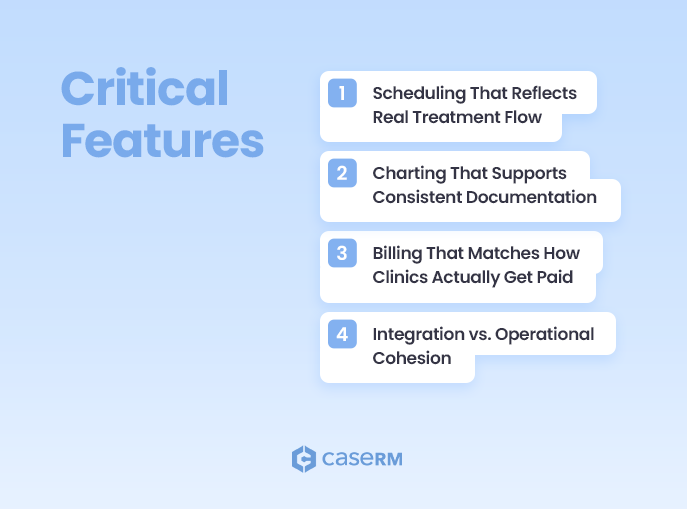
1. Scheduling That Reflects Real Treatment Flow
In acupuncture, a 60-minute appointment does not always mean 60 minutes of direct provider time. A visit may include intake, setup, needle placement, retention time, and follow-up. In busy clinics, appointments may also overlap across rooms, practitioners, and shared resources.
The scheduling system should support that flow without making the calendar confusing. Look for clear calendar views, recurring appointment support, room and provider coordination, online booking, and the ability to manage more than one schedule at a time.
Multi-calendar functionality is especially important. Clinics often need visibility across practitioners, rooms, equipment, and shared resources—not just a single appointment list. A stronger calendar structure helps the front desk and clinical team stay aligned throughout the day.
2. Charting That Supports Consistent Documentation
Charting should help practitioners document care clearly while keeping the workflow practical and efficient. For acupuncture clinics, that may include treatment notes, progress updates, care plans, visit history, clinical observations, and supporting documents.
Speed matters, but consistency matters more. In many visits, the previous note is the natural starting point. Practitioners should be able to copy a prior note, review it, update what changed, and complete the current visit note without losing the clinical thread.
Documentation structure also matters. When every note sits in one long patient timeline, it becomes harder to separate different conditions, treatment plans, or care episodes. A case-based approach keeps documentation organized around the specific issue, plan, or episode of care being managed.
3. Billing That Matches How Clinics Actually Get Paid
Acupuncture clinics may manage private payments, insurance claims, prepaid packages, partial payments, multiple services, online payments, payment processing, adjustments, invoices, and account balances.
The billing system should show what was billed, what was paid, and what remains outstanding without forcing staff to rely on notes, reminders, or spreadsheets.
For clinics managing multiple cases, providers, or payers, billing should stay connected to the right client, case, appointment, invoice, payment, and balance.
4. Integration vs. Operational Cohesion
Integration does not always mean cohesion. In some systems, it only means two tools can exchange limited information while staff still move between screens, repeat steps, or reconcile details manually.
Before choosing a platform, look at whether scheduling, documentation, billing, contacts, patient profiles, and financial activity work together as one workflow. If a booking changes, a payment is posted, or a chart note is completed, the related record should stay connected without extra tracking.
The stronger the operational cohesion, the less the clinic depends on workarounds. This becomes more important as providers, staff, services, and patient volume grow.
Transitioning Systems Without Disrupting Your Clinic
Data migration is one reason clinics stay with software that no longer fits. Patient records, appointment history, billing activity, chart notes, forms, and attachments represent years of clinical and operational history, so the move needs to be planned carefully.
Some data usually transfers more cleanly than others. Basic demographics such as names, phone numbers, email addresses, and mailing addresses can often be exported and imported through spreadsheets. More complex records, including appointment history, balances, invoicing history, payments, attachments, custom chart templates, and old clinical notes, may not map neatly into a new system.
Switching platforms should be treated as an operational project, not just a technical task. Before moving, clinics should decide what must be transferred, what should remain accessible for reference, how active patients will be handled, and what staff need before go-live.
The safest transitions are planned around continuity. Clinics should avoid switching systems in a rush or during peak treatment periods. A structured rollout gives the team time to verify records, test workflows, train staff, and reduce disruption to scheduling, billing, and patient care.
For a deeper breakdown, read our guide on Data Transfer From One Practice Management Software to Another.
Final Thoughts: Where the Industry Is Headed
Acupuncture practice management software is moving away from fragmented tools toward more connected systems. Clinics no longer want separate platforms for scheduling, charting, billing, payments, marketing, and reporting. That setup may work early on, but it often leads to duplicate work, unclear financial visibility, and workflow gaps as the practice grows.
The next stage of practice management is not just about having more features. It is about how well those features work together. Stronger systems connect the clinical, administrative, and financial sides of the clinic in one coordinated workflow.
Interface design also matters. A modern system should feel clean, organized, and practical to use every day. A dated or cluttered interface can slow adoption, increase training time, and make the software feel disconnected from how clinics want to operate.
For acupuncture clinics, growth rarely follows a straight line. A solo practitioner may add another provider, a front-desk administrator, a second location, or complementary services such as physiotherapy, chiropractic care, naturopathy, or massage therapy. Software that fits on day one may not support the clinic three years later.
That is why software selection should look beyond immediate convenience. The better question is whether the platform can support more providers, more calendars, more complex billing, more documentation requirements, and more than one type of care.
The right acupuncture practice management software should support today’s appointments, charting, and billing while giving the clinic room to become more coordinated, multidisciplinary, and operationally mature.