CaseRM has entered a new chapter.
The first version of CaseRM was released in 2014 with an ambitious goal: to create flexible case management software that could support organizations whose work did not fit neatly into rigid, predetermined workflows.
That original release gave us the opportunity to test new ideas, work directly with organizations, and better understand how teams manage clients, patients, cases, appointments, billing, documentation, and day-to-day operations.
We learned what worked, what needed to change, and where traditional practice management software often fell short.
CaseRM 2.0 is the result of that experience.
Code-named Silo, the second version of CaseRM was redesigned and rebuilt from the ground up as a more modern, clean, and powerful cloud-based practice management platform. It combines adaptive case management with the operational tools needed to manage a growing health and wellness clinic or other case-driven organization.
Why We Rebuilt CaseRM
The first version of CaseRM helped us prove that a case-centric approach could give organizations more flexibility than conventional contact-based or appointment-based systems.
However, software expectations have changed considerably since 2014. Organizations increasingly expect cloud-based access alongside modern interfaces, better collaboration, integrated billing, online services, and the ability to manage multiple locations from one system.
Rather than continuing to build on an aging foundation, we decided to start again.
CaseRM 2.0 applies the knowledge gained through the original release while introducing a redesigned interface, an improved system architecture, and a more connected approach to case management, clinic operations, appointment scheduling, accounting, billing, and clinical documentation.
Code Name Silo: Secure Multi-Tenant Architecture
The code name Silo reflects the multi-tenant architecture behind CaseRM 2.0.
In CaseRM, a tenant represents an organization. Each organization operates within its own isolated data environment, or silo, separate from every other organization using the platform.
A tenant may operate from one location or manage multiple clinic locations under the same account. Additional locations can be added during the initial setup or later as the organization grows.
This structure makes CaseRM suitable for:
- Solo practitioners
- Single-location health and wellness clinics
- Multi-location healthcare practices
- Multidisciplinary clinics
- Case management organizations
- Professional service teams
Authorized team members can work within one connected cloud-based practice management system while access permissions help control what each person can view and manage.
Practice Management Software Built Around Case Files
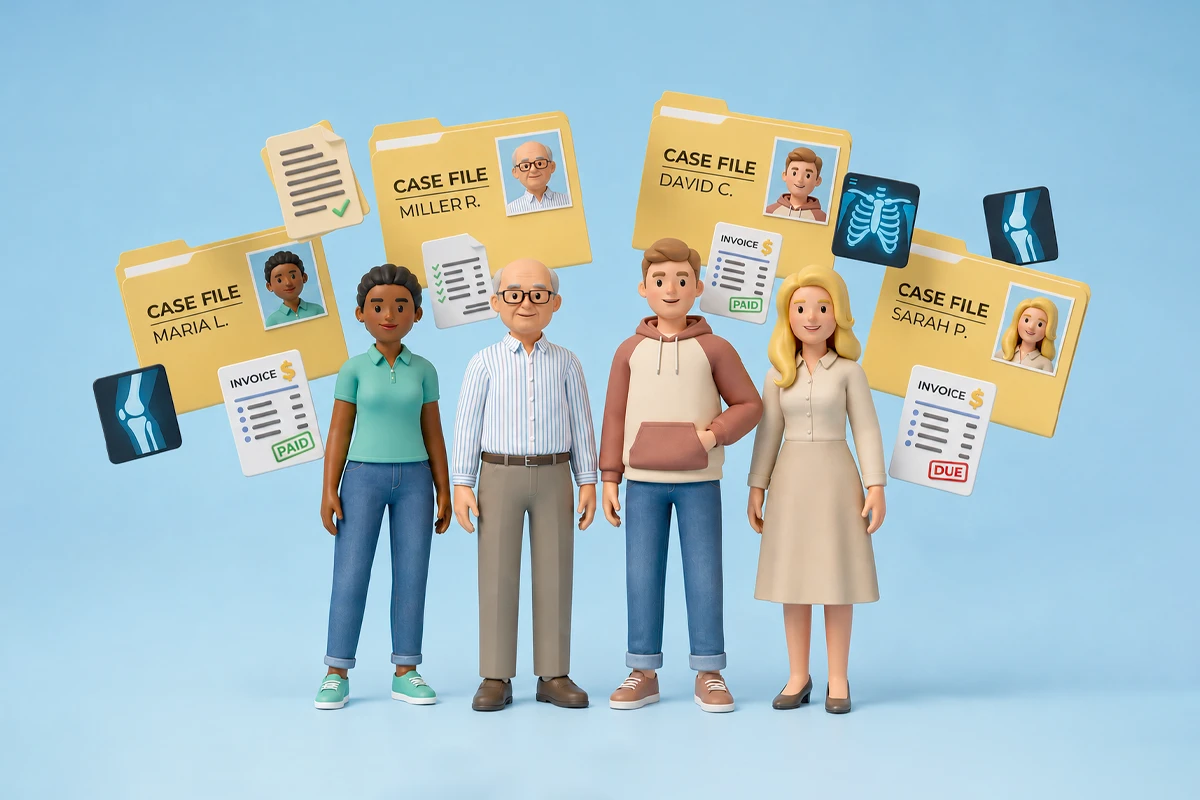
Most traditional practice management software is built primarily around contacts, patients, or appointments. CaseRM takes a different approach by placing the case file at the centre of the system.
A client or patient may have more than one active matter, condition, funding source, or episode of care. Instead of combining everything into one continuous record, CaseRM allows organizations to create separate case files while maintaining a connection to the same contact.
For example, a patient receiving ongoing treatment for chronic pain may later be involved in a motor vehicle accident. The original private or extended health benefits case can remain separate from the new accident-related case, with each case maintaining its own billing arrangements, documentation, treatment plans, appointments, contacts, and financial history.
This case-centric structure helps clinics organize complex information without losing the complete relationship with the client or patient.
Core CaseRM 2.0 Features
CaseRM 2.0 brings essential clinic management and case management functions together in one connected platform.

Case File Management
Create and manage multiple case files for the same client or patient. Each case can contain its own contacts, notes, appointments, billing information, financial activity, and supporting records.
Contact Management
Maintain a centralized contact directory for clients, patients, providers, insurers, lawyers, adjusters, referral sources, vendors, and other professional contacts.
Appointment Scheduling Software
Manage provider calendars, treatment rooms, equipment, shifts, breaks, appointment statuses, recurring appointments, and multi-location schedules through an integrated calendar.
Because scheduling is connected to the rest of CaseRM, appointments do not exist as isolated calendar entries. They can be associated with case files, services, providers, billing activity, and clinical documentation.
Accounting
Manage financial activity through built-in accounting tools for recording payments, expenses, transactions, and other financial records.
Because accounting is connected with case files, appointments, providers, and billing activity, clinics can maintain a clearer view of their operations without relying entirely on a separate accounting system.
Private Billing
Create charges, invoices, and payments for services billed directly to clients or patients.
CaseRM connects private billing activity with the appropriate case file, appointment, service, and provider, helping clinics maintain organized and traceable billing records.
Team and Multi-Location Management
Manage team members, access permissions, providers, clinic locations, and organizational settings from one cloud-based system.
Additional CaseRM Modules and Features
CaseRM can be extended with additional modules and features that support clinical documentation, patient engagement, and clinic workflows.
Online Charting
Create clinical documentation using flexible charting tools designed for healthcare and rehabilitation professionals. Chart notes can be connected directly to the appropriate appointment, provider, patient, and case file.
Online Booking
Allow clients and patients to request appointments online, helping clinics reduce administrative work and make scheduling more convenient.
Online Forms
Collect intake forms, consent forms, and other information electronically before the patient arrives at the clinic.
Together, these features help clinics improve information collection, streamline administrative processes, and create a more connected experience for staff and patients.
What Is Adaptive Case Management?
Adaptive case management, commonly shortened to ACM, is an approach to managing work that changes as new information becomes available.
Traditional workflow management software usually expects work to follow a predefined sequence. That approach may work well for repetitive processes, but it becomes restrictive when decisions depend on professional judgment, changing circumstances, or newly discovered information.
Adaptive case management gives knowledge workers more flexibility to decide what should happen next based on the current circumstances of the case.
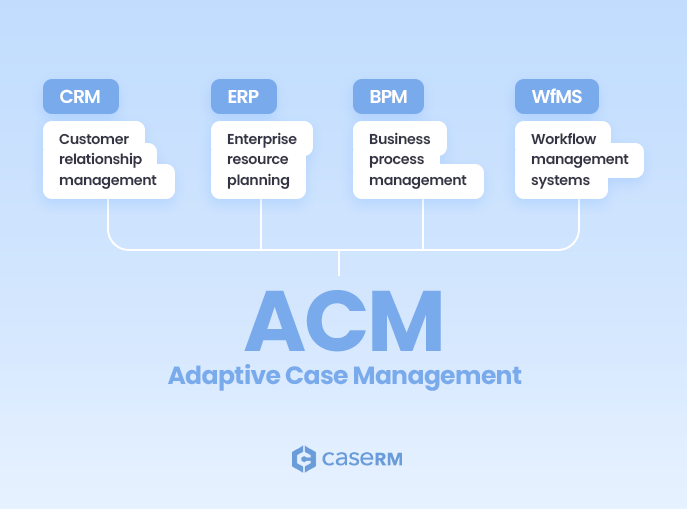
ACM combines concepts commonly associated with:
- Customer relationship management
- Business process management
- Workflow management systems
- Enterprise resource planning
- Document and information management
- Team collaboration
Instead of forcing every case through exactly the same workflow, adaptive case management software supports the people responsible for reviewing the information and making informed decisions.
Why Adaptive Case Management Works for Healthcare Clinics
Healthcare does not always follow a predictable sequence.
A treatment plan may change after a reassessment. A new injury may require a separate case file. Insurance coverage may be exhausted. A new payer may become involved. A provider may replace one planned service with another based on the patient’s progress.
Traditional clinic management software often treats each appointment as a separate transaction. CaseRM is designed to preserve the wider context surrounding the patient, condition, treatment plan, payer, provider, and financial activity.
This makes adaptive case management particularly useful for:
- Physiotherapy clinics
- Chiropractic clinics
- Massage therapy clinics
- Acupuncture clinics
- Psychology and mental health practices
- Occupational therapy providers
- Speech-language pathology clinics
- Rehabilitation and assessment centres
- Multidisciplinary health and wellness clinics
The goal is not to remove structure. It is to provide enough structure to keep work organized without preventing healthcare professionals and administrative teams from responding to real-world changes.
More Than Traditional Practice Management Software
CaseRM 2.0 is not simply an appointment calendar with patient records attached.
It is being developed as a connected, case-centric practice management platform where scheduling, case management, contact management, billing, accounting, charting, online booking, forms, and reporting support one another.
This connected approach can help clinics:
- Reduce duplicate data entry
- Keep patient and case information organized
- Separate different conditions or funding arrangements
- Coordinate work between providers and administrative staff
- Manage billing alongside clinical and operational activity
- Support single-location and multi-location growth
- Adapt workflows when circumstances change
CaseRM is designed to give organizations a clearer picture of each case while also supporting the broader operations of the practice.
Continuing the CaseRM Journey
The launch of CaseRM 2.0 is an important milestone, but it is not the end of the project.
We will continue expanding the platform with new clinic management, billing, charting, communication, reporting, and workflow capabilities. Each addition will be developed with the same objective: to help organizations manage complex work without making the software itself unnecessarily complicated.
Through the CaseRM blog, we will share product updates, practical clinic management guidance, software comparisons, billing insights, and discussions about adaptive case management and the future of healthcare practice software.
The first version of CaseRM, released in 2014, gave us the foundation. The lessons learned since then helped us build something substantially better.
CaseRM 2.0 is more modern, more capable, and better prepared for the changing needs of today’s clinics and case-driven organizations.
This is the next stage of CaseRM—and we are only getting started. Keep checking the CaseRM roadmap for product updates, upcoming features, and a closer look at what we are building next.