You’re reviewing a patient file with an unusual combination of symptoms, clinical findings, and supporting reports, and you want another perspective. Opening ChatGPT or Copilot takes seconds. Uploading the relevant information or typing in the key details takes another minute. Then comes the hesitation: should this patient information actually be entered here?
That hesitation is becoming increasingly common in Canadian health and wellness practices.
Artificial intelligence is no longer being used only to draft emails, rewrite website content, or summarize general information. Physiotherapists, chiropractors, physicians, mental health professionals, and other providers are starting to use AI as something closer to a clinical assistant.
They may want help working through a difficult case, reviewing an imaging report, comparing findings across several documents, finding relevant clinical evidence, or organizing an opinion or report.
That is a very different use of AI from reviewing an email or helping formulate an appointment reminder. It also brings the technology much closer to patient care, where the quality of the answer and the handling of personal health information become considerably more important.
And it raises an obvious question: What AI should a Canadian healthcare provider use when the conversation may contain patient information?
AI Is Moving Beyond Documentation
Much of the discussion around artificial intelligence in healthcare has focused on the AI scribe.
That makes sense. AI scribes can listen to a clinical encounter and turn the conversation into a structured note, saving providers time on clinical documentation.
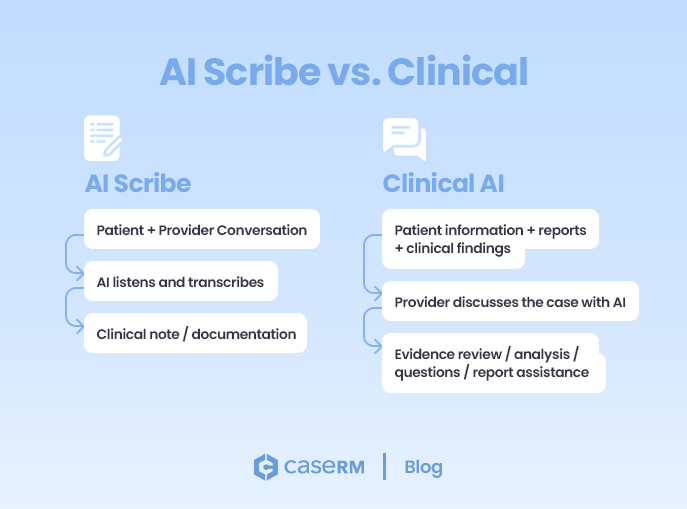
But a scribe mainly solves one problem: it listens to the conversation between the patient and provider and turns it into documentation.
Clinical AI plays a different role. Instead of simply recording what happened, it allows the provider to have a conversation with the AI, explore the case, ask follow-up questions, and work through the available information.
That can include questions such as:
- What differential considerations or red flags should I keep in mind?
- How do these imaging or assessment findings fit with the clinical presentation?
- What does current evidence say about this condition?
- Can you summarize these records and identify information that supports or contradicts my clinical opinion?
- Can you help organize the findings into a report?
This is where narrative synthesis becomes especially valuable. Clinical files are rarely clean datasets. They are often a mix of progress notes, imaging, consultations, subjective complaints, objective findings, and reports written at different points in time. A useful clinical AI should be able to bring that information together without losing the context behind it.
Behind many of these tools is generative AI, built using advances in machine learning, deep learning, and natural language processing. Modern systems may rely on a large language model trained through a complex neural network to understand clinical language and produce a conversational response.
The technical details are not something every clinic needs to master, but they help explain why these systems can do much more than a traditional chatbot. They can interpret context, summarize long records, and generate new text rather than simply follow predefined rules.
The more clinically useful the AI becomes, however, the more patient context it may need. And that is where patient privacy becomes a much bigger concern.
Why ChatGPT and Claude Became the Natural Starting Point
It is easy to understand why providers reach for general generative AI tools such as ChatGPT, Microsoft Copilot, Claude, or Grok.
They are familiar, conversational, flexible, and remarkably capable. They can work through complicated questions, review documents, and handle follow-up questions without forcing the user into a rigid workflow.
There is almost no learning curve:
“Here is what happened. Here are the findings. Here is the report. What do you make of it?”
For general work, these tools can be extremely useful.
Their conversational design can also make them feel less like traditional software and more like an intelligent chatbot that can keep track of a discussion as it develops.
The issue becomes more complicated when identifiable personal health information enters the prompt.
There is a major difference between asking AI:
“Help me make these treatment instructions easier for a patient to understand.”
and:
“Review this patient’s medical history and treatment records and tell me whether the clinical findings support my opinion.”
Those are not the same privacy problem.
What Should a Clinical AI Be Able to Do?
Before comparing products, it helps to define what we are actually looking for.
A useful clinical AI should ideally be able to do more than transcribe.
Have a genuine clinical conversation. A provider should be able to add new information, challenge an answer, ask follow-up questions, and explore alternatives.
Work with patient context. A generic answer is one thing. An answer that considers the patient’s history, findings, and supporting documents is much more useful.
Analyze uploaded documents. This can include imaging reports, specialist consultations, previous assessments, treatment records, referral documents, functional evaluations, insurer reports, and information exported from electronic health records.
Synthesize complex clinical narratives. The system should be able to bring together information collected over time, identify recurring or conflicting findings, and help the provider understand the case as a whole rather than treating every document in isolation.
Help organize evidence. If a physiotherapist or chiropractor is preparing a clinical opinion, progress report, discharge report, or insurer report, AI can help connect findings with supporting information.
Work from verifiable clinical evidence. A strong clinical AI should not rely only on what the underlying large language model learned during training. Ideally, it should be able to retrieve current guidelines and medical literature, cite the source, and give the provider a way to verify the evidence behind the answer.
Recognize the strength of different sources. Not all evidence carries the same weight. A clinical guideline, systematic review, case report, and general web page should not be treated as equivalent simply because all four can be cited.
Respect scope of practice. A useful clinical assistant should recognize that a physiotherapist, chiropractor, psychotherapist, and family physician may approach the same information from different professional roles.
Recognize uncertainty and bias. A sophisticated machine learning system can still produce an overly confident or incomplete answer. Providers also need to remain aware of algorithmic bias, particularly when the information used to train or evaluate a system does not adequately reflect the patient population being served.
These criteria start to narrow the field.
Before Discussing a Patient With AI, Ask These Five Questions
It is easy to come up with a 30-question vendor checklist. Most clinicians are not going to read one.
These five questions are a better place to start.
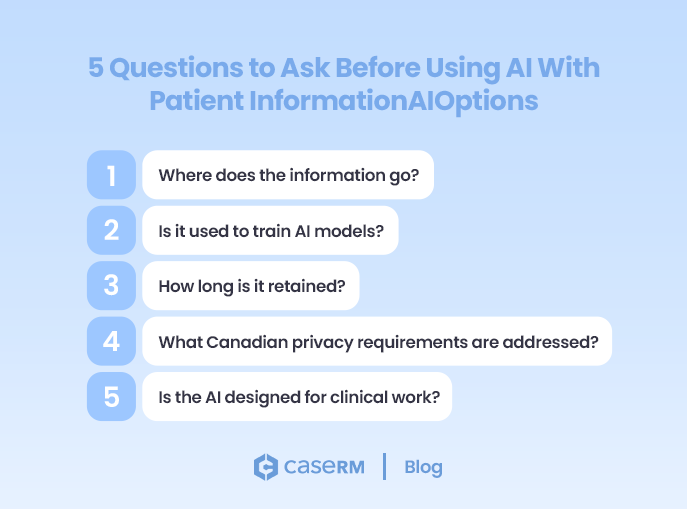
1. Where does the patient information actually go?
Do not stop at asking where the data is stored.
Ask where it is processed, backed up, sent for AI inference, and whether other companies or subprocessors handle it.
A vendor may store information in Canada while still sending it elsewhere for part of the AI processing. This is why data sovereignty involves more than simply asking whether a company has Canadian servers.
2. Is patient information used to train or improve AI models?
This deserves particular attention.
When a provider gives AI patient information to answer a clinical question, that information is being provided for a specific purpose. If the vendor also keeps it to train or improve its machine learning models, it is now being used beyond the original clinical task.
That can raise questions about consent, secondary use, and control. Once information becomes part of a training dataset or influences a deep learning model, removing it may be far more difficult than deleting a saved record. Models can also memorize parts of their training data, creating the possibility that sensitive information could influence future outputs.
The clinic may also lose control over how long that information remains in use. A patient sharing information during treatment would reasonably expect it to support their care, not to improve a technology company’s commercial AI product.
That is why a clear statement that personal health information is not used to train AI models is an important safeguard.
At the same time, “product improvement” and “model training” are not always the same thing. A vendor may use anonymous usage statistics, error reports, ratings, or aggregated data without training the underlying AI on patient conversations.
3. How long is the information retained?
What happens after the conversation ends?
Does the service keep chat history, transcripts, uploaded reports, generated notes, temporary processing data, or backups?
Can the provider delete them? Can the clinic control the retention period?
A system that retains information indefinitely has a very different privacy profile from one that gives the clinic control over retention and deletion.
4. What does the provider say about Canadian privacy requirements?
For this article, our main focus is on PIPEDA and the privacy claims each provider makes publicly.
Other provincial privacy or health-information rules may also apply depending on the province, the type of practice, and the information being handled. We do not attempt to certify whether a product satisfies every applicable law.
Instead, we report the provider’s own stated position as accurately as possible and avoid reading more into it than is actually published.
As digital health continues to develop across the Canadian health care system, organizations such as Canada Health Infoway form part of a much broader conversation about health information, interoperability, and how new health technologies fit into clinical practice. Individual clinics still need to evaluate the specific AI service they intend to use.
5. Is the AI actually designed for clinical work?
A Canadian-hosted AI service may offer strong privacy protections, but that alone does not make it a clinical AI.
For clinical use, look for:
- reliable clinical evidence sources;
- citations you can verify;
- patient-context support;
- strong medical terminology;
- report and document analysis;
- clinical decision-support capabilities;
- relevant specialty coverage;
- safeguards against overly confident conclusions.
Privacy is only part of the picture. The quality of the clinical output is just as important.
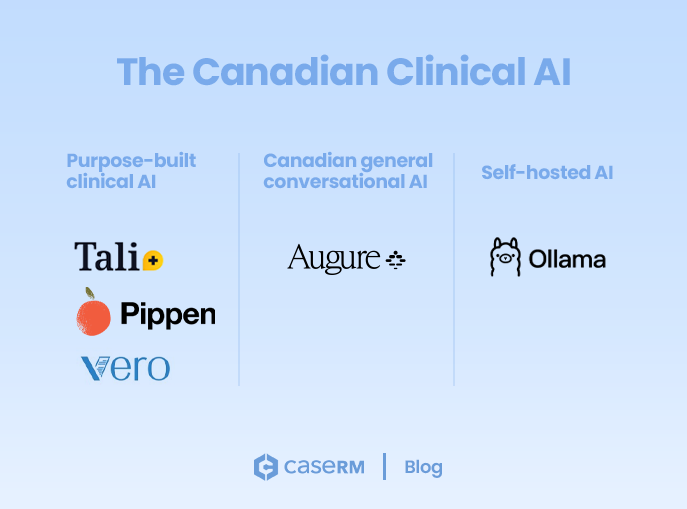
The Canadian Clinical AI Options That Stand Out
The Canadian market is still developing, and many products continue to position themselves mainly as AI scribes. A smaller group, however, is moving beyond clinical documentation into clinical conversation, evidence review, patient-context analysis, and decision support.
For this article, we focused on products that appear most relevant to the kind of work providers are already trying to do with general AI tools: discuss a case, review records, explore evidence, and help organize a professional opinion or report. Our recommendations reflect the Canadian clinical AI landscape as it stands in 2026.
Based on the public information we reviewed, three Canadian clinical AI platforms stand out. Vero appears particularly well suited to allied-health providers who want clinical conversation and evidence-supported document analysis. Tali has one of the strongest Canadian healthcare privacy and EMR-integration positions. Pippen offers a genuine interactive clinical assistant, although its focus is more closely tied to family medicine.
Vero Looks Particularly Interesting for Clinical Conversation and Evidence Review
At first glance, Vero looks like another AI medical scribe.
Look a little deeper and it becomes much more interesting.
Its platform includes Vero Chat, clinical decision-support features, patient context, document uploads, and Vero Evidence, an integrated evidence search tool.
That brings it much closer to the kind of use case we are exploring.
A physiotherapist could bring together examination findings and supporting documents and ask a clinical question in context. A chiropractor reviewing a complicated file could upload the relevant records, compare findings, and ask the AI to identify supporting or conflicting evidence.
A complex patient file may include:
- patient history;
- previous treatment records;
- diagnostic imaging;
- specialist reports;
- objective examination findings;
- outcome measures;
- current functional limitations.
The interesting use is not simply:
“Summarize these documents.”
It is:
“Compare the reported symptoms with the objective findings. Identify supporting and conflicting information. Show me evidence relevant to the condition. Then help me organize my clinical opinion while clearly separating facts, observations, and conclusions that still require professional judgment.”
That starts to look much closer to the way providers currently use ChatGPT.
Vero’s ability to combine clinical discussion, document analysis, and evidence retrieval is especially useful for narrative synthesis, where the goal is not merely to summarize each report but to understand how the information fits together across the entire file.
Where Vero looks strongest
Vero appears particularly well suited to allied-health providers who want to ask evidence-supported clinical questions, review and analyze documents, prepare reports, and work through patient-specific information in context. It may also appeal to practices looking for clinical AI without the complexity of a large enterprise implementation.
Where we would remain cautious
Most detailed claims about any vendor’s clinical capabilities naturally come from the vendor itself.
That does not mean the claims are wrong, but clinicians should treat the AI’s conclusions and citations as material to review, not as an independent clinical opinion.
There is also the risk of automation bias. When an AI produces a polished, well-structured answer with references attached, it can be easy to give that answer more weight than it deserves. The provider still needs to check the original record, review the cited evidence, and decide whether the conclusion actually fits the case.
That applies to every product discussed here.
Tali AI Has One of the Strongest Canadian Healthcare Privacy Positions
Tali is another Canadian company that started with documentation and dictation but has expanded into broader clinical decision support.
Its Clinical Medical Search is particularly interesting. Tali can use patient context captured during an encounter to refine clinical questions and places strong emphasis on Canadian clinical sources. That Canadian evidence emphasis is a real strength, since a general clinical AI may not always distinguish between Canadian and American guidelines, drug availability, screening recommendations, terminology, billing practices, or other local standards.
Tali also has one of the clearest privacy positions we found, with explicit references to PIPEDA, Canadian storage, and Canadian processing.
Where Tali looks strongest
Tali is particularly compelling for Canadian physicians and practices that want strong EMR integration, access to Canadian clinical sources, and clear privacy positioning. Its connection to electronic health records also makes it attractive for clinicians who want clinical search and AI scribing to fit into an existing workflow rather than live in a separate application.
Where it may be less ideal
Tali appears more structured around clinical search within an encounter than around a completely open ChatGPT-style workspace for uploading a large collection of reports and working through a complex file over time.
For some providers, that will be exactly what they need. For a physiotherapist or chiropractor wanting to upload a substantial assessment file and have a long analytical conversation around the evidence, Vero currently appears closer to that workflow.
Pippen Is a Genuine Clinical AI Assistant but Is Heavily Physician-Focused
Pippen also deserves attention because it clearly positions itself as more than a scribe. Its broader capabilities include an interactive AI assistant, clinical insights, differential diagnosis and treatment support, referral-letter generation, billing and diagnostic-code suggestions, along with dictation and scribing.
Its privacy positioning is straightforward, with references to Canadian hosting, PIPEDA, and SOC 2 Type II.
The main limitation for an allied-health audience is its focus. Pippen is built around Canadian family physicians.
That does not mean a physiotherapist or chiropractor could not find it useful, but it makes Pippen a less natural fit for allied-health practices than a platform designed around a wider range of specialties.
Pippen would rank much higher on our shortlist for a Canadian family doctor. In a multidisciplinary rehabilitation clinic, however, we would currently lean toward a broader clinical AI platform.
What About a Canadian Version of ChatGPT?
Not every provider wants a highly structured clinical workflow. Sometimes the requirement is much simpler:
“Give me something like ChatGPT, but designed around Canadian privacy and data sovereignty.”
That is where Augure becomes particularly interesting.
Augure offers general AI chat, document analysis, search, and other AI capabilities in a familiar conversational format. Unlike the clinical platforms discussed above, it is not built primarily around encounters, charting, or AI scribing. That can be an advantage for providers who want the flexibility to upload documents, ask follow-up questions, work through a case, and use generative AI in much the same way they would use ChatGPT.
Augure also has a strong Canadian privacy position. Its public material states that conversations, documents, and account data are stored in Canada, customer content is not used to train or fine-tune AI models, and inference is handled through Canadian infrastructure and zero-retention arrangements. Augure also positions its platform for Canadian healthcare organizations and describes its healthcare offering as PIPEDA- and Law 25-aligned.
There is one important distinction. Augure is a general AI platform used in a healthcare setting, rather than a purpose-built clinical decision-support system. It does not appear to provide the same integrated clinical evidence search, specialty-specific workflows, or patient-context features offered by platforms such as Vero or Tali.
That does not rule it out. For providers looking for a Canadian alternative to ChatGPT for reviewing documents, discussing cases, drafting reports, and working through clinical information conversationally, Augure deserves a place on the shortlist.
The choice comes down to what you want from the AI. If integrated clinical evidence and healthcare-specific decision support are the priority, a purpose-built clinical platform has the advantage. If flexibility, conversational AI, document analysis, and Canadian data sovereignty are more important, Augure becomes a very compelling option.
The Third Option Is to Keep the AI Inside Your Practice
There is another approach that rarely comes up in discussions about Canadian healthcare AI: running the AI locally instead of sending the clinical conversation to an external provider.
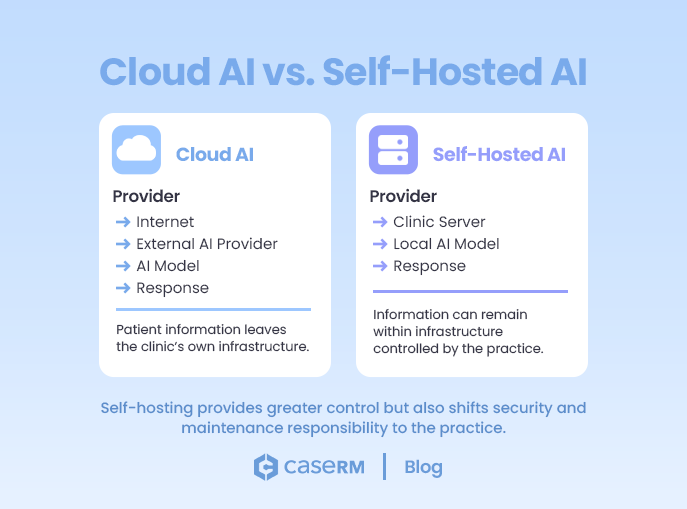
Tools such as Ollama make it possible to run a large language model on a local computer or server. Combined with a self-hosted interface such as Open WebUI, a practice can create something that looks and behaves surprisingly like a private ChatGPT environment.
In that setup, the conversation stays within infrastructure controlled by the practice rather than being sent to an external AI provider. That creates a fundamentally different privacy model and gives the clinic much more direct control over personal health information.
Why self-hosting is appealing
A properly designed local setup can give the practice much more control over where conversations are stored, who can access them, how long they are retained, how backups and logging are handled, which model is used, and whether the system needs Internet access at all.
For highly sensitive clinical analysis, that level of control is attractive. A provider could potentially upload patient records and reports without sending them to an external AI company.
But self-hosted does not mean automatically compliant
Self-hosting simply shifts responsibility. With a cloud AI provider, the question is largely can we trust the provider’s infrastructure and safeguards? With self-hosted AI, the question becomes can we properly secure our own environment?
That means the clinic takes responsibility for disk encryption, authentication, access permissions, backups, ransomware protection, software updates, physical security, audit logs, remote access, and disaster recovery.
For larger practices, adopting this kind of infrastructure can also become a change management project rather than simply a software installation. Staff need to understand when the system should be used, what information can be entered, and who is responsible for maintaining it.
Running AI Privately Is Easier Than Running Excellent Clinical AI Privately
Getting a model running locally is no longer especially difficult.
Choosing one you are comfortable using for clinical discussion is another matter.
A practice still needs to ask:
- How capable and current is the model?
- How well does it handle medical literature?
- Can it work through long clinical records and multiple uploaded documents?
- Does it provide reliable citations?
- How often does it hallucinate or overstate conclusions?
- Has it been validated for the type of clinical task being performed?
There is another important distinction: a local language model is not the same thing as a complete clinical AI system.
A purpose-built clinical platform may add current medical knowledge retrieval, evidence databases, specialty-specific prompts, safety controls, document-processing tools, and other layers around the underlying model. Running a model locally gives the practice control over the infrastructure, but those clinical capabilities still have to come from somewhere.
The same applies to the underlying technology. A general machine learning or deep learning model may be excellent at language generation without being optimized for clinical evidence, medical retrieval, or safe decision support.
A self-hosted model may therefore offer much stronger control over patient information while providing weaker clinical assistance. A practice with strong technical resources may decide that a private model combined with carefully controlled medical reference material is worth exploring. A smaller clinic without IT support may be better off using a reputable managed clinical AI platform than maintaining an insecure “private” AI server under someone’s desk.
Removing the Patient’s Name Does Not Necessarily Make the Prompt Anonymous
A common workaround is to use ChatGPT without including the patient’s name. That is certainly better than entering obvious identifiers, but it does not automatically protect patient privacy.
A prompt could still include details such as age, location, occupation, accident date, an unusual diagnosis, specialist, insurer, or treatment history. Taken together, those details may still make the person identifiable.
Removing a name is not the same as properly de-identifying a case.
Clinical AI Should Help Form an Opinion, Not Become the Opinion
The ability to upload evidence and ask AI to help draft a report may be one of the most useful applications for allied-health providers, but it can also be easy to misuse.
Take a physiotherapist preparing an insurer report. There is nothing unreasonable about using AI to help:
- organize large volumes of records;
- build a clear chronology;
- identify recurring or conflicting findings;
- improve the structure of the report;
- locate relevant research;
- draft sections based on the provider’s instructions.
The important distinction is that the final clinical opinion must still remain the provider’s. AI can help surface patterns, summarize evidence, and suggest that the material appears to support certain considerations, but it should not become the source of the professional opinion itself.
This is also where automation bias deserves attention. A polished AI-generated report can sound convincing even when part of the reasoning is incomplete or wrong. Providers still need to verify the facts, review the sources, consider conflicting evidence, stay within their scope of practice, and make sure the final report reflects their own professional judgment.
Used appropriately, these tools can support patient care and potentially improve the patient experience by reducing some of the time clinicians spend organizing information. But responsibility for the clinical decision remains with the provider.
In other words, use AI as a research and analytical assistant, not as the professional whose signature appears at the bottom of the report.
So Which Clinical AI Would We Choose?
Based on the products and public information currently available, the answer depends on the type of practice.
Our first look for allied health — Vero
For physiotherapy, chiropractic, mental health, rehabilitation, and multidisciplinary practices, Vero is the product we would currently explore first, particularly where document analysis, evidence-supported clinical discussion, and report preparation are priorities.
Our first look for Canadian physician workflows — Tali
For Canadian physicians, especially those working inside established Canadian EMRs, Tali may be the stronger starting point because of its Canadian clinical sources, EMR integrations, and patient-context-aware medical search.
Also worth considering for family medicine — Pippen
Pippen is a strong option for Canadian family physicians who want an interactive clinical AI assistant. Its narrower focus makes it less compelling for allied-health and multidisciplinary practices.
A strong Canadian ChatGPT-style option — Augure
For providers who want the flexibility of a general conversational AI rather than a structured clinical workflow, Augure is a strong option to consider. Its combination of document analysis, open-ended conversation, Canadian data handling, and healthcare-oriented privacy positioning makes it one of the more interesting Canadian alternatives to mainstream general AI.
The privacy-control choice — self-hosted AI
For practices with capable IT support and a strong reason to keep information under their own control, Ollama with a self-hosted interface such as Open WebUI is a legitimate option. It requires more technical responsibility and should not be assumed to match the clinical reasoning of a specialized cloud platform, but it offers a level of infrastructure control that managed services cannot.
Where This Leaves ChatGPT, Grok, Claude, Copilot, Gemini, and Other Mainstream AI
None of this means health professionals need to stop using mainstream AI. The better approach is to match the AI environment to the type of information being used.
For general tasks such as rewriting a clinic policy, drafting a social-media post, or summarizing generic medical research without including patient information, mainstream generative AI may be perfectly suitable.
The situation changes once the prompt includes patient-specific information. A request such as:
“Here is my patient’s history, examination, imaging report, and previous treatment. Help me work through this.”
brings privacy, data handling, and clinical suitability into the decision. That is where a Canadian clinical AI, or in some circumstances a properly secured self-hosted AI, starts to make much more sense.
The Clinical AI Conversation Is Just Beginning
The growth of artificial intelligence in healthcare is part of a wider shift toward digital health, but AI scribes answered an important first question: can AI listen to the clinical encounter and help us document it?
The next question is more interesting: can AI participate meaningfully in the clinical discussion without compromising the information patients have entrusted to us?
Canadian providers can already choose from purpose-built clinical AI platforms, broader Canadian AI services, and self-hosted models that keep more of the environment under the practice’s control. As machine learning continues to advance and clinical digital health tools become more capable, the right choice will still depend on the work being done, the information being shared, and how much technical responsibility the practice is prepared to take on.
Before entering a patient’s history into whichever AI happens to be open in the browser, it is worth taking a closer look at the alternatives now available. Whatever platform a practice chooses, five questions are worth keeping in mind:
- Where does the information go?
- Is it used to train or improve AI models?
- How long is it retained?
- Which Canadian privacy requirements does the provider explicitly address?
- And is the AI actually designed for the clinical work you are asking it to perform?
Those questions do not replace a proper privacy assessment, but they are a far better starting point than simply asking whether an AI is “secure.”