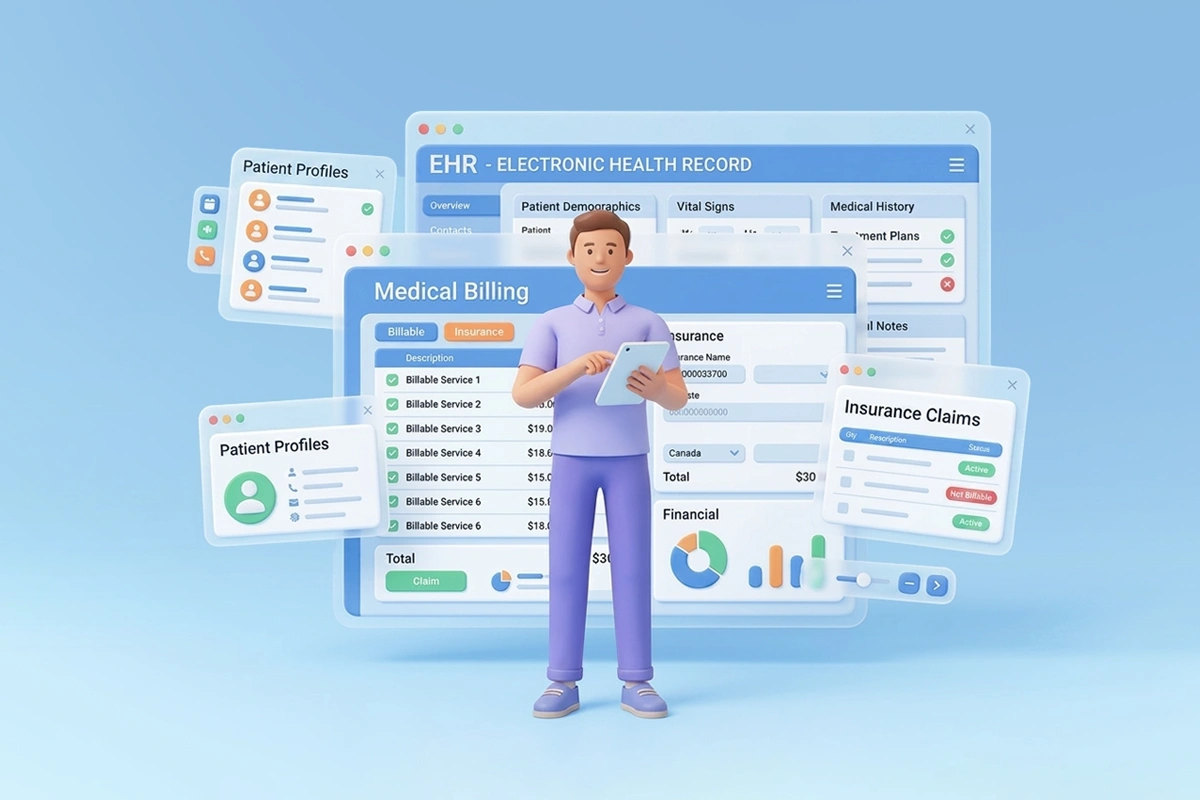
In an era where health and wellness clinics are rapidly embracing digital tools, practice management software has become the backbone of efficient clinic operations in Canada. This article explores the landscape of Canadian practice management systems in 2026, outlining what modern clinics expect from these platforms and providing a comprehensive list of medical practice management software built by Canadian vendors and tailored to health and wellness practices.
We’ll look at how these systems are designed at a high level, highlight different approaches across the market – from scheduling-centric apps to documentation-driven EMRs – and explore a case-centric architectural approach represented by CaseRM. Whether you operate a physiotherapy clinic, mental health practice, chiropractic office, or multidisciplinary wellness center, the goal is to provide clarity on how these systems differ, the problems they are designed to solve, and how the Canadian market has evolved.
The Canadian Practice Management Software Market in 2026
The cloud-based practice management software market for health and wellness clinics in Canada has grown into a diverse ecosystem by 2026. What was once a market dominated by a few generic systems has evolved into one offering dozens of options, including both foreign-built platforms and solutions designed specifically for Canadian practitioners. Digital adoption continues to gain ground, with electronic record systems now used by most healthcare professionals and providers in Canada. This digital shift, hastened by the pandemic era, means clinics across the country – from big urban physiotherapy centers to solo counseling practices in small towns – are increasingly running on software rather than paper.
One striking aspect of the Canadian landscape is how homegrown many solutions are. International medical software giants exist, but Canadian clinics often favor local vendors attuned to Canadian requirements. Factors like bilingual support, strict privacy laws (e.g. PIPEDA, PHIPA), and integration with provincial healthcare systems (for insurance billing and claims) make Canadian practice management unique. Indeed, a number of Canadian companies have sprouted to fill these needs – some backed by professional associations (for example, the Ontario Chiropractic Association’s own software), others born as startups by clinicians-turned-entrepreneurs. As a result, the market today spans everything from long-established, operations-heavy systems to sleek new all-in-one cloud apps offering AI-driven features.
Overall, Canadian clinics in 2026 benefit from a crowded yet vibrant market. Choice abounds, and competition drives vendors to keep improving. In the next sections, we’ll break down what modern clinics expect from these systems, then group the software vendors by their focus or architectural approach. By understanding the landscape and the available products, clinic owners and practitioners can make informed decisions to find the best medical practice management software for their specific needs.
Canadian Practice Management Software Vendors (2026)
The Canadian market for practice management software includes a mix of long-established providers and newer platforms built specifically for health and wellness clinics. The vendors listed below represent software developed by Canadian firms supporting a range of clinical, administrative, and billing workflows across the country.
- CaseRM
- Adracare
- GOrendezvous
- Practice Jewel
- Medexa
- MRX Solutions Corp
- OutSmart Electronic Medical Records
- Practice Perfect
- Treehouse Digital Health Inc.
- Clinicmaster
- ChiroSUITE
- Jane App
- Juvonno
- Noterro
- OCA Aspire
- Owl Practice
- Embodia
- Universal Office (Antibex)
- WalnutEMR
- Juno EMR
- Practice Better
- ClinicSense
- Max Systems Inc
The digital shift across Canadian health and wellness clinics
Remember when paper charts and a physical appointment book were the norm? Those days are fading fast. Today, even the most traditional clinics recognize that digital transformation isn’t a luxury; it’s a necessity for efficiency, patient experience, and growth. This isn’t a trend; it’s the new baseline.
Why practice management software is now core infrastructure
A single appointment now touches scheduling, clinical documentation, billing rules, insurance eligibility, reporting, and patient communication. Multiply that by multiple practitioners, treatment plans, and payers, and the software becomes the system holding the clinic together.
From basic scheduling tools to full healthcare management software
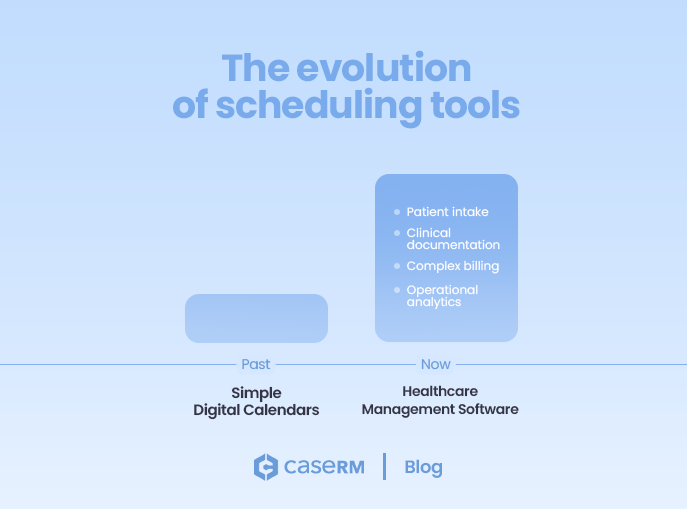
The journey has been remarkable. What started as simple digital calendars has blossomed into sophisticated, all-encompassing healthcare management platforms. These systems now handle everything from patient intake and clinical documentation to complex billing and operational analytics, all designed to streamline your entire practice.
What Clinics Expect From Modern Practice Management Software
Let’s talk about what makes a practice management system truly effective. It’s more than just a list of features; it’s how these features integrate to create a seamless workflow.
Scheduling and online booking systems
This is often the entry point. Patients expect to book appointments online, 24/7. Your software needs to handle complex schedules, multiple practitioners, various service types, and even recurring appointments with ease. It should be intuitive for both your patients and your front desk staff.
Online booking is no longer a differentiator — it’s table stakes. Clinics expect real-time availability, patient self-service, automated reminders, waitlists, and multi-provider scheduling to work together without creating administrative friction behind the scenes. When scheduling feels clunky or unreliable, patients notice immediately, and staff end up compensating with manual work.
A well-designed appointment scheduling and online booking system quietly does its job: it reduces no-shows, keeps calendars accurate, and sets the tone for a professional, well-run clinic from the very first interaction.
Billing, invoicing, and payments across clinic workflows
Billing and invoicing sit at the core of a clinic’s financial operations. Your software should generate clear, professional invoices, track outstanding balances accurately, and keep billing tightly connected to appointments, services, and case files. Invoices should be easy to create directly from a scheduled appointment in the calendar or from a client’s case file — in just a few clicks.
User experience matters here more than almost anywhere else. Creating and managing invoices is one of the most frequent tasks administrators perform every day. If the workflow is slow, cluttered, or inconsistent, the inefficiency compounds quickly across the clinic.
Modern systems must also support a mix of billing scenarios — private pay, extended health benefits, accident and third-party claims, and in many cases provincial billing — without forcing duplicate data entry or workarounds. Payments are the final step, not a separate process. When billing and payments are designed as part of one continuous workflow, administrative load drops, errors decline, and clinics stay focused on care instead of cleanup.
Clinical documentation and SOAP-based charting
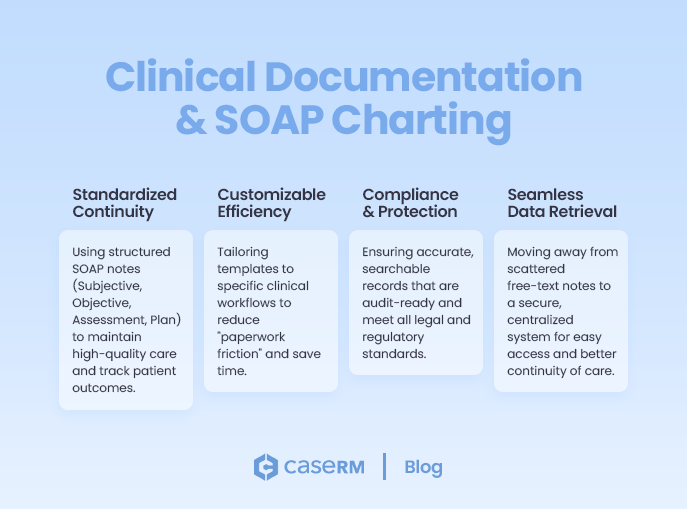
This is where the rubber meets the road for patient care. Structured, searchable clinical documentation is no longer a bonus — it’s expected. Clinics rely on it to support audits, track outcomes, maintain continuity of care, and protect the integrity of the clinical record.
Robust documentation tools are non-negotiable: SOAP notes, customizable templates, and secure storage all need to work together in a way that reflects how clinicians actually practice. Charting should be accurate, consistent, and easy to retrieve later — not buried in free-text notes or scattered across the system.
The real goal is efficiency without compromise. Good documentation software reduces paperwork friction, supports compliance, and frees practitioners to spend their time where it matters most: delivering care, not wrestling with forms.
Reporting, visibility, and operational insight
Clinic owners expect real-time visibility into revenue, utilization, no-shows, and growth trends. Knowing your numbers isn’t optional if you’re serious about running a sustainable clinic.
Your practice management software should deliver clear, actionable insight into how the clinic is actually performing: appointments booked, revenue generated, utilization rates, cancellations, and no-show rates. This data isn’t just for looking backward or exporting reports for accounting. It’s how owners spot issues early, adjust staffing, refine scheduling, and make informed decisions before small problems turn into expensive ones.
Good reporting turns day-to-day activity into operational clarity — and gives clinic leaders the visibility they need to shape the clinic’s future proactively, rather than react to it after the fact.
Security, privacy, and Canadian healthcare compliance
In Canada, patient data privacy is paramount. PIPEDA — along with provincial regulations like PHIPA — sets a high bar, and your software needs to meet it by design. This isn’t an optional extra or a premium feature; it’s a fundamental requirement.
Baseline expectations include Canadian data residency, strong security protocols, detailed audit logs, and role-based access controls that ensure the right people see the right information — and nothing more. These are not differentiators. They’re the minimum cost of entry.
The system you choose should act like a fortress for sensitive information, with compliance baked into the architecture rather than bolted on after the fact. When security and privacy are handled properly, clinics don’t have to think about them — and that’s exactly how it should be.
Why Practice Management Software in Canada Is Different
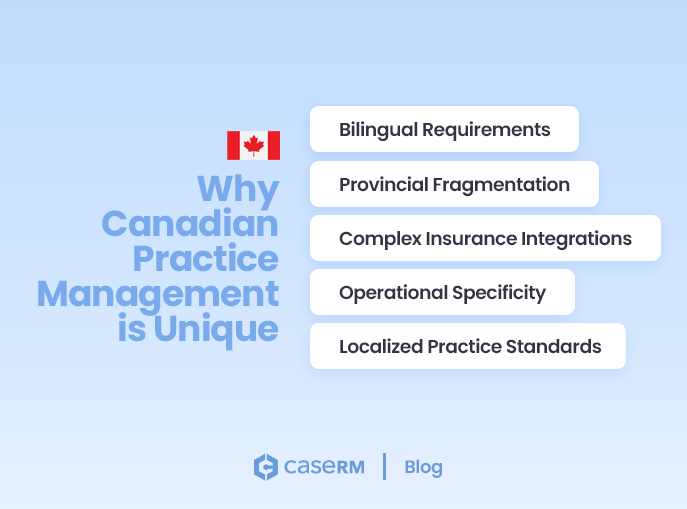
Canadian clinics operate under a different set of realities than their counterparts elsewhere, and practice management software has to reflect that. While security, privacy, and regulatory compliance are baseline requirements (as outlined above), they are only part of the picture.
One uniquely Canadian consideration is bilingual support. In provinces like Quebec — and in federally regulated contexts — software often needs to support both English and French in a practical, usable way.
The biggest differentiator, however, is insurance billing. Healthcare billing in Canada is fragmented by province, with each jurisdiction operating its own systems, rules, and workflows. In Ontario alone, clinics may need to manage OHIP billing, submit motor vehicle accident claims through HCAI using OCF forms, and process workplace injury claims through WSIB eServices. Other provinces introduce their own platforms, such as TelePlan for MSP billing in British Columbia, Manitoba Health billing systems, insurer portals like ProviderConnect, and TELUS Health eClaims for extended health submissions across Canada.
The result is operational complexity. A clinic in Toronto may require tight integration with WSIB eServices and HCAI, while a Vancouver-based wellness clinic may care far more about BC TelePlan support. One size does not fit all — and not every practice management system handles these workflows out of the box. Even among those that claim to, the depth of integration and day-to-day usability can vary widely.
Beyond billing, Canadian-focused systems often align more closely with local practice standards, forms, and workflows — whether that’s physiotherapy assessments, chiropractor WSIB documentation, or province-specific reporting requirements. These localized needs are why many Canadian clinics gravitate toward domestic software built explicitly for this market, rather than international platforms that lack the necessary integrations or require heavy customization to function properly.
Private-pay workflows: largely universal
Most Canadian clinics still rely heavily on private payment. While this simplifies parts of the billing process, it also puts more pressure on efficiency and the overall patient experience.
For purely private-pay services, the workflows themselves are largely universal. Patients receive care, patients pay, and the clinic processes that payment. The core mechanics — scheduling, invoicing, collecting payment, and recording it properly — translate cleanly across borders and closely resemble how private-pay clinics operate internationally.
Because the fundamentals are so consistent, the real differentiator isn’t geography. It’s how cleanly the software supports those workflows without slowing staff down or creating friction for patients at the point of payment.
Extended health benefits and TELUS Health eClaims
Direct billing through TELUS Health eClaims is deeply embedded in Canadian clinics — and the quality of that integration varies widely between platforms.
A significant portion of patients rely on extended health benefits, and smooth integration with TELUS Health eClaims is a genuine game-changer. When done properly, it allows clinics to bill many major insurers directly, reducing patient out-of-pocket costs and eliminating a pile of manual administrative work for your team.
When the integration is shallow or unreliable, staff end up re-entering data, chasing errors, and explaining delays to patients. If your practice management software doesn’t support solid, end-to-end TELUS Health eClaims integration, you’re not just creating friction — you’re leaving efficiency and patient trust on the table.
Provincial and incident-based billing realities
Auto insurance programs (HCAI), WSIB, OHIP, TelePlan, and other provincial variants introduce layers of billing complexity that generic, internationally built software often struggles to handle cleanly. These systems aren’t just different fee schedules — they come with incident-based rules, payer-specific workflows, and reporting requirements that need to be baked into the software, not bolted on afterward.
While provincial health billing may be less common for many private health and wellness clinics, understanding and supporting systems such as TELUS Health eClaims, HCAI, and OHIP remains essential for many practices across Ontario. Even if your clinic doesn’t bill these programs today, your software’s architecture should be flexible enough to handle evolving billing models as your practice grows or diversifies. When billing complexity shows up — and it usually does — rigid systems become blockers instead of support.
Why similar integrations can produce very different admin experiences
Two systems might both claim to integrate with TELUS Health eClaims, but the user experience can be vastly different. One might make it a seamless, one-click process, while another requires multiple steps and workarounds. This is where subtle design choices profoundly impact your daily operations.
Design Patterns Across Practice Management Software
Beyond feature lists, it’s the underlying “design patterns” – how the software is fundamentally built – that truly dictate its long-term utility.
Why design patterns matter more than feature lists
A feature list is like a menu at a restaurant. It tells you what’s available. But the design pattern is the chef’s skill, the quality of the ingredients, and the overall kitchen workflow. A poorly designed system, even with many features, will create friction and frustration. A well-designed system, even with fewer initial features, will be intuitive and adaptable.
Patient-centric practice management systems
The most effective systems are built around the patient journey. From the initial booking to follow-up communication, every module and workflow is designed to enhance the patient experience and provide a holistic view of their interactions with your clinic.
Case-centric architecture as an emerging model
An increasingly powerful approach is “case-centric” architecture. Instead of just a series of appointments, the software understands a patient’s journey as a “case” or “episode of care.” This allows for better tracking of treatment plans, progress, and outcomes over time, providing deeper insights and more coherent care delivery.
Trends Shaping Practice Management Software in Canada
The market isn’t static. Understanding these trends will help you choose a system that grows with you, not against you.
Why feature parity is misleading
Just because two systems have similar features on paper doesn’t mean they’re equally capable. “Feature parity” can be a red herring. It’s about the quality of those features, their integration, and how well they solve real-world problems. One system might have a reporting feature, while another provides truly insightful, customizable dashboards.
How clinic growth exposes architectural limits
What works for a solo practitioner with 20 patients a week might completely break down for a multi-location clinic with 500 patients. Growth puts immense pressure on a software’s underlying architecture. A system built on shaky foundations will buckle under increasing complexity, leading to bottlenecks and inefficiencies.
The long-term impact of software foundations
Investing in robust software is like investing in a well-built commercial property. It costs more upfront, but it pays dividends for years to come through stability, scalability, and adaptability. Cheap, quick solutions often lead to costly headaches down the line.
Final Perspective on a Crowded but Maturing Canadian Market
The Canadian market for practice management software is dynamic. Many players exist, but not all are created equal.
Canadian-built software and regional realities
While global solutions exist, Canadian-built software often has an inherent advantage. They understand the nuances of Canadian healthcare compliance, payment systems (like TELUS Health eClaims), and regional expectations without needing extensive localization. This can lead to smoother implementation and fewer headaches.
Stability, adaptability, and long-term viability
Look for vendors with a proven track record, transparent pricing, a clear development roadmap, and a commitment to customer support. You’re not just buying software; you’re entering a long-term relationship. Can the vendor adapt to future changes in regulations or technology? Will they be around in five years?
Where practice management software is heading next
Expect more AI-driven insights, enhanced telehealth integrations, and even deeper analytics to help clinics optimize every aspect of their operations. The future is about proactive management and personalized patient experiences, all powered by intelligent software.
FAQs: Common Questions About Practice Management Software in Canada
Let’s tackle some common questions that often pop up.
What exactly is practice management software, and how is it different from an EMR/EHR?
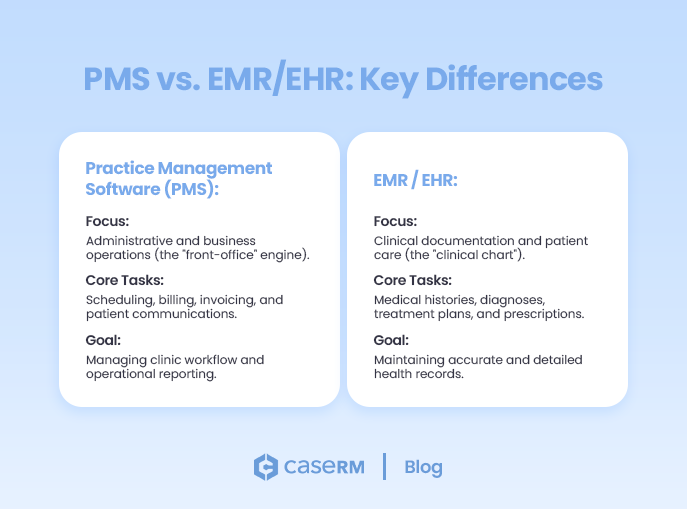
Practice management software (PMS) focuses on the administrative aspects of running a clinic: scheduling, billing, invoicing, patient communication, and operational reporting. An Electronic Medical Record (EMR) or Electronic Health Record (EHR) primarily focuses on clinical documentation – patient histories, diagnoses, treatment plans, prescriptions, etc. Many modern PMS systems include EMR/EHR functionalities, but their core purpose is distinct. Think of PMS as the front-office and business engine, and EMR as the clinical chart.
Is online booking really the same across all practice management software platforms?
Absolutely not! While most platforms offer online booking, the user experience can vary wildly. Some offer basic appointment slots, while others provide sophisticated features like waitlists, automated reminders, pre-payment options, complex service linking, and integration with practitioner-specific availability. The key is to test it from both the patient and administrator perspectives. A truly seamless online booking system is a powerful patient acquisition and retention tool.
Why does billing feel harder in some practice management systems than others?
Billing complexity often stems from how deeply the system understands and integrates with Canadian-specific payment workflows. Systems that poorly integrate with extended health benefits (like TELUS Health eClaims) or lack flexibility for different service codes and fee schedules will invariably make billing a laborious process. The ease of generating invoices, tracking claims, and applying payments efficiently is a huge differentiator. A well-designed system simplifies complex billing, minimizing errors and freeing up your staff’s time.
Do clinics eventually outgrow their practice management software?
Yes, they can, especially if the initial software choice was based solely on current needs without considering future growth. As a clinic expands (more practitioners, more locations, new service lines, higher patient volume), a system with limited scalability, rigid architecture, or poor reporting capabilities will become a bottleneck. This is why understanding the software’s “design patterns” and the vendor’s long-term vision is critical from day one. You want a partner that can scale with you, not force you into another costly migration in a few years.