You don’t notice how disconnected your systems are when things are quiet.
It shows up when the clinic gets busy.
A full day of appointments wraps up, charges are partially recorded, notes are completed at different times, and billing gets pushed to the end of the day—or the next. By the time invoices go out, details need to be double-checked, adjustments are made manually, and reporting no longer reflects what actually happened that week.
This is a familiar reality for many small practices, independent practices, and growing specialty healthcare practices trying to balance operations and patient care.
None of this happens because people are careless. It happens because the system isn’t built to carry the workflow from care delivery through to billing and financial tracking without breaking it into pieces.
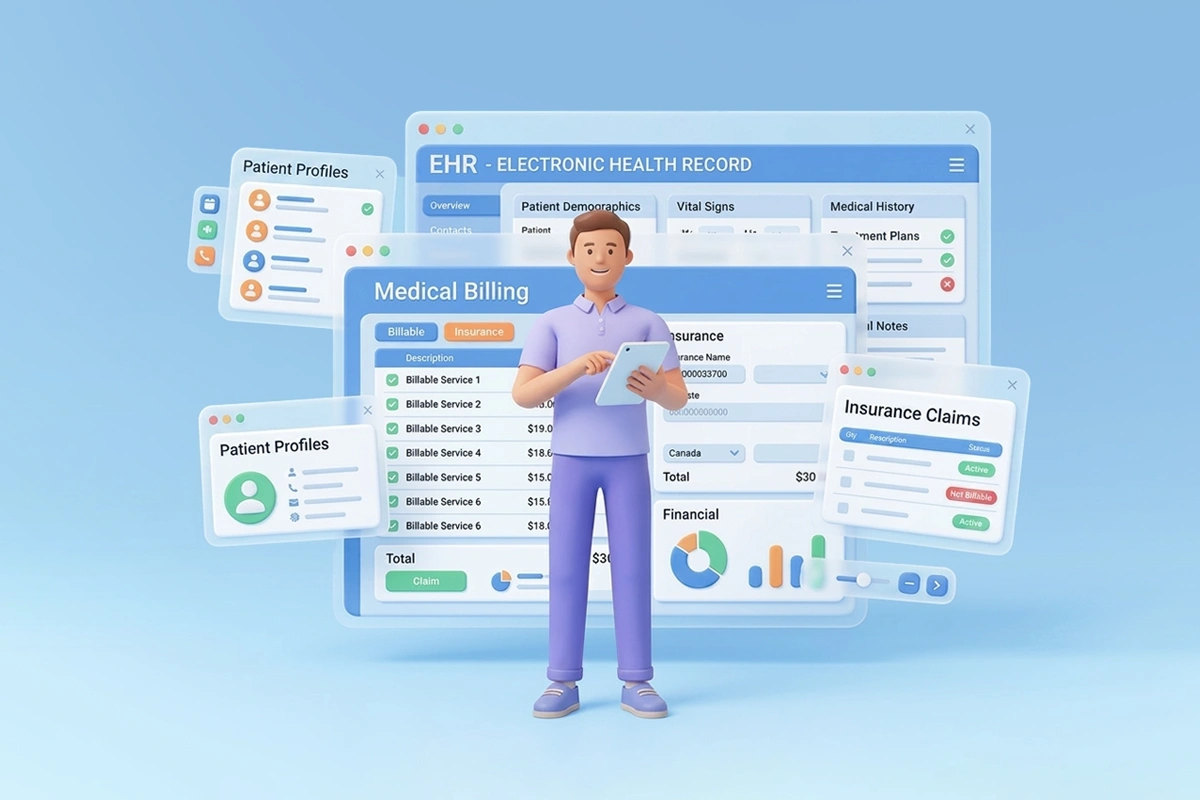
The right medical billing software doesn’t just send invoices or replace external billing services. It aligns your electronic health records, scheduling, and billing into one consistent workflow that reflects how clinics actually operate.
Connected Where It Makes Sense, Unified Where It Matters
Not every system needs to be rebuilt from the ground up.
Modern medical billing software should support interoperability to optimize workflows and streamline administrative tasks.
Integrations with tools like QuickBooks, payment processors, and clearinghouses are not only useful—they’re expected. For many small practices, these integrations are essential.
But problems arise when core workflows depend on them.
When scheduling, charting, and billing processes live in separate systems, data must be transferred, interpreted, and verified after the fact. That creates delays, errors, and unnecessary administrative burden.
If your core workflow depends on syncing data between systems, the system isn’t unified. It’s stitched together. The result is a medical billing solution that adds friction instead of reducing it.
Most clinics don’t lose revenue because they lack effort. They lose it because their systems separate the work from the billing.
The Workflow: From Check-In to Reimbursement
Real-Time Eligibility and Scheduling
The calendar is the operational hub of any clinic. For small practices, this matters even more with no excess staff to offset inefficiencies. Scheduling needs to handle multiple providers, treatment rooms, equipment, and sessions without constant workarounds.
Rigid systems add administrative burden, especially in small medical practices. A flexible, user-friendly, cloud-based scheduler lets healthcare providers manage real-world constraints smoothly.
Closing the Gap Between Care Delivery and Billing
In practice, billing is a coordinated workflow, not a single step.
A patient checks in. A charge attaches to the case. The provider delivers care, completes chart notes, and flags any additional services or adjustments for the front desk.
From there, paths branch naturally: invoice issued and payment collected, insurance billed with verified eligibility, or charges held for cases like MVA or slip-and-fall until ready.
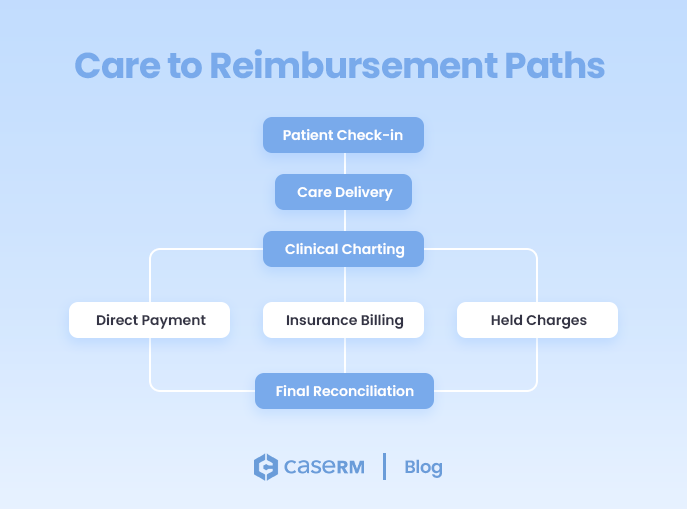
This workflow is consistent across most small practices and larger clinics. The issue isn’t the workflow. It’s how most medical billing software supports it. Staff switch screens, charges misalign, updates require manual tweaks, and billing fragments.
A well-designed billing solution supports this process end-to-end. Everything ties to the case: charges stay in context, providers and front desk share clear information, updates apply easily, and billing matches exactly what happened. The workflow stays the same. The friction disappears.
Billing That Reflects How Care Is Delivered
Billing That Lives at the Case Level (Not Just the Patient)
Most medical billing software centers on patient records, not cases. For small practices, this creates duplicate profiles, fragmented records, and inconsistent reporting.
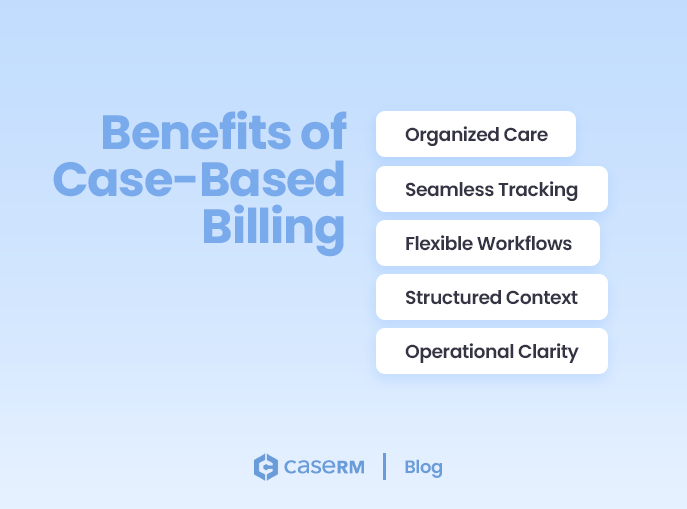
A case-based structure fixes this. Each patient can have multiple distinct case files tracking services, documentation, billing workflows, and financial activity. This aligns billing with real care delivery.
Clinics can group services logically, track financials per case, and maintain clarity across timelines—essential for healthcare practices handling insurance, payer claims management, or legal claims.
Billing Delays That Impact Cash Flow
Disconnected systems cause inevitable delays. Charges record, but invoicing waits for manual verification, service compilation, or admin follow-up. For small practices, these delays hit cash flow directly. Revenue is earned but not captured consistently.
Over time, outstanding balances rise, reporting weakens, and visibility drops. The best medical billing software removes delays by aligning billing with care: charges accumulate within the case, invoices issue at the right moment, and revenue captures steadily. Cash flow becomes predictable instead of reactive.
Eliminating the “Data Silo” Headache
One Patient, One Record, Zero Redundancy
Fragmented systems breed duplicates and errors. For independent practices, this adds risk and inefficiency. A unified, scalable electronic health records system delivers one clean patient profile with multiple structured cases and consistent data across modules. Accuracy and reporting improve as volumes grow.
Built-In Financial Logic (Not Bolted-On Accounting)
Many platforms stop at invoicing, forcing exports and manual rebuilds in external tools. For small practices, this means duplicated effort, inconsistent categorization, and unreliable reports.
Without a built-in financial structure, billing data never fully translates into usable financial insight — it just moves between systems.
A complete medical billing solution embeds financial logic: proper chart of accounts, categorized transactions, and integrated reporting. This eliminates reconstruction and boosts accuracy without extra tools.
Advanced Analytics for Practice Growth
Visualizing Your Financial Health
Reporting is where most medical billing software falls short. It is not just delayed or export-dependent. In many cases, the reports simply do not exist or lack the detail that small practices actually need to run their operations.
Vendors often struggle to keep up with reporting demands. Some systems are limited by how they were built. Others fail to interpret what users are asking for. In many cases, requests for new or improved reports are either misunderstood or ignored altogether. The result is a set of reports that feel incomplete, disconnected, or unusable in day-to-day decision-making.
Even when reports are available, they are often missing critical information. Key data points are scattered, totals do not align, and users are left piecing together numbers manually just to understand what is happening in their own clinic.
A well-designed system takes a different approach. While dashboards are important, very few medical billing systems offer them, and those that do often provide limited or even irrelevant information. When implemented properly, dashboards give a quick, real-time snapshot of activity the moment a user signs in, highlighting key items such as revenue trends, outstanding invoices, and payment activity.
However, dashboards are not a substitute for proper reporting and should not be treated as such. Statistical and financial reports serve a different purpose. They provide the depth, structure, and accuracy needed to truly understand performance over time.
For small practices, both are essential. Dashboards offer immediate visibility, while well-designed reports provide the level of detail required to run the business with confidence.
Without reliable reporting, decisions are based on assumptions rather than actual performance.
Identifying Bottlenecks in the Revenue Cycle
Accurate data reveals hidden patterns: billing delays, claims processing and claim submission rejections, and scheduling inefficiencies. Strong medical billing software surfaces these early, letting healthcare providers address revenue cycle management issues before they escalate and supporting steady growth.
A Modern Patient Experience
The Digital Front Door
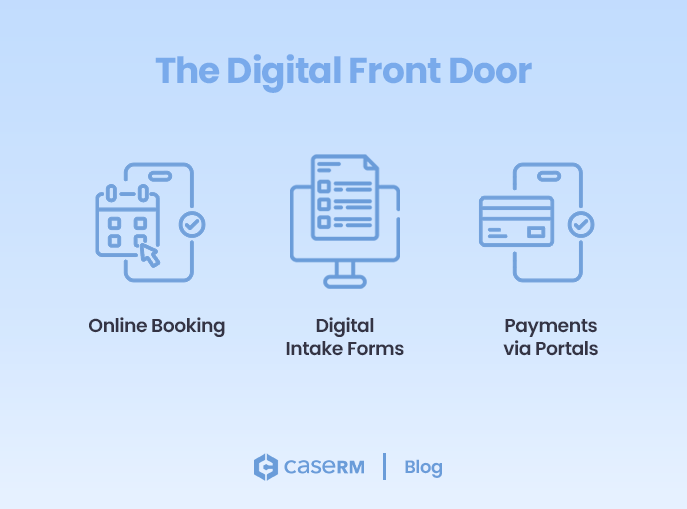
Patients expect convenience: online booking, digital intake forms, and easy payments via portals. Integrated systems deliver this, boosting patient engagement while cutting front-desk workload.
Transparent Billing That Builds Trust
Clear billing does more than improve collections. It directly shapes how patients experience your clinic and how confidently they engage with your services.
When patients understand what they are being charged for, the entire interaction becomes more straightforward. Payments are processed faster because there is less uncertainty around balances. Disputes are reduced because charges are clearly tied to documented services. Communication improves as well, since both staff and patients are working from the same, consistent information.
This level of transparency matters, especially for small practices where relationships are central to long-term retention. When billing is structured and easy to follow, staff spend less time explaining invoices and resolving confusion. In turn, clinics can focus more on delivering consistent, high-quality patient care without unnecessary administrative friction.
Pricing That Supports Growth
Most medical billing software platforms complicate pricing.
You pay per user, then pay again for features, and often upgrade tiers just to access functionality you may never use.
For growing clinics, this creates friction quickly. Every new hire becomes a cost decision, and essential tools are bundled with features that don’t apply to your workflow.
A better model keeps pricing straightforward. Unlimited full-time users have full access to core functionality, including case file management, contact management, scheduling, accounting and private billing, as well as reporting and dashboards.
From there, pricing is based on the functionality you actually need, delivered through targeted add-ons rather than restricting user access. This keeps costs predictable, removes the need to structure your team around software limitations, and allows the system to scale naturally with your clinic.
You are not paying to unlock users. You are paying for tools that support how your practice operates.
That is the difference between pricing that supports growth and pricing that holds it back.
Traditional Systems vs. Case-Based Practice Management
Most clinics don’t realize how much their system is working against them until they compare it to something structured differently.
The difference becomes clear when you look at how systems behave side by side.
Traditional Medical Billing Software
- Patient-centric structure that requires creating multiple patient profiles for each new case or incident
- No built-in accounting system, leaving financial tracking disconnected from billing
- Billing typically limited to one invoice per service date, with limited flexibility across ongoing care
- No centralized address book, resulting in separate records for clients, team members, referrals, suppliers, and legal representatives
- Limited or rigid calendar structure that does not naturally support providers, rooms, and equipment without workarounds
- Per-user pricing limits access as teams grow
This setup works only until volume increases. At that point, delays, inconsistencies, and administrative overhead begin to surface.
Case-Based Medical Billing Solution
- Built around case files tied to real-world incidents
- Multiple services grouped naturally within each case
- Billing aligned with the care workflow, rather than added later
- Scheduling, documentation, billing, and reporting within one system
- Real-time dashboards that reflect current data without reconstruction
- Unlimited full-time users across all core functionality
This structure doesn’t change how clinics operate; it supports it properly. That difference becomes more noticeable as the clinic grows.
Before making a change, most clinics ask a few practical questions.
Frequently Asked Questions
What is the difference between integrated and case-based medical billing software?
Integrated medical billing software connects scheduling, documentation, and billing within a single system. A case-based approach goes further by organizing all activity, including appointments, charges, documentation, and financials, around individual case files rather than just patient profiles.
For small practices, this results in more accurate billing, more reliable reporting, and workflows that are easier to manage.
Is case-based billing only useful for insurance or legal cases?
No. While case-based billing is essential for insurance, MVA, and legal scenarios, it also improves everyday operations within the clinic.
For small practices, structuring billing around cases allows for better organization of treatment plans, clearer tracking of services over time, and more flexible billing workflows that reflect how care is actually delivered. Even routine private billing becomes easier to manage when it is tied to a structured case, rather than treated as a series of disconnected visits.
How does unlimited user pricing benefit small practices?
Most medical billing software charges per user, which creates limitations as teams grow and roles expand.
With unlimited full-time users across core functionality, clinics can provide providers, front desk staff, and administrative teams with full access to the system without restriction. This removes the need to restructure roles or limit usage based on licensing constraints and allows the practice to scale without increasing software costs each time a new team member is added.
Instead of paying per user, clinics pay for the functionality they actually need, aligning costs with how the practice operates rather than how many people require access.
Final Thoughts: Structure Matters More Than Features
Choosing the right medical billing software isn’t about counting features. It’s about structure. When the system aligns with real clinical workflows—especially for small practices—billing flows smoother, reporting turns reliable, administrative burden decreases, and patient care benefits directly.
A platform built around how your practice actually works will always outperform one forcing constant workarounds.
Ready to See the Difference?
If your current medical billing software feels like disconnected pieces, consider a unified, case-based medical billing solution. It simplifies operations, sharpens reporting, and supports long-term growth for small practices and independent practices.
Book a walkthrough and compare it to your current setup.